Resources · Snow removal
Slip-and-fall on a lot you plowed: how the claim actually unfolds
The honest answer is that the fall is the least important part of the claim. What decides it is a letter that shows up months later, a contract clause you signed in September, and whether your log from that night says anything at all. We insure snow removal contractors across Colorado and we plow commercial lots in Fairplay ourselves, so here is how a slip-and-fall on a lot you plowed actually moves, step by step, from the night of the storm to the check. Nothing in it is exotic. Most of it is paperwork.
The night of the storm
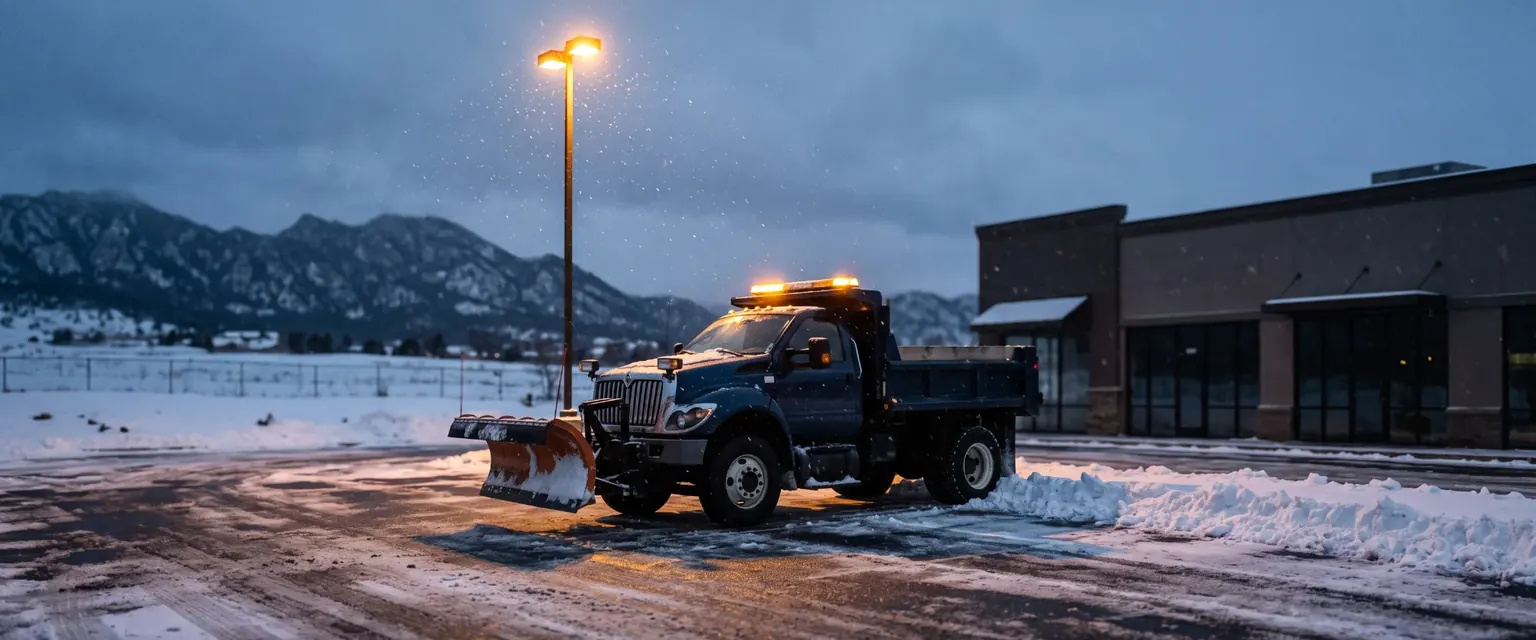
A February upslope storm drops four inches on an office park in the Denver Tech Center. Your driver runs the lot at 2 a.m. in the F-350 with a Boss V-blade, stacks the piles at the north end, and the crew salts the walks. Everything is clean at 4. Then the sun comes out at noon, the Chinook melt runs across the entrance, and it refreezes at dusk. At 6:15 a tenant walks out to her car, goes down on the ice, and breaks a wrist.
Nobody calls you. The tenant goes to urgent care. The property manager might hear about it that week, or might not. Your driver does the next storm and the one after that. The season ends. You put the plow in the shed.
That was the fall. Here comes the claim.
The letter
Somewhere between May and the following winter, a letter arrives from an attorney. It names the property owner, the management firm, and your outfit. It describes the injury, says the walks were not reasonably maintained, and asks for your insurance information and a copy of your contract. Sometimes it asks for the service records first.
Two things happen at once here, and they matter more than the letter itself.
First, you tender the claim to your general liability carrier. That means you send the letter to us, we send it to the carrier, and an adjuster opens a file and assigns defense counsel. Under most standard forms, the GL provides the defense for a covered bodily injury claim, and on a slip-and-fall the defense is often the bigger number. The general liability page explains what “covered” turns on, and the short version is that snow and ice operations have to be on the policy. If your GL was written for landscaping and never heard about the plow route, the summer-and-winter gap article is the one to read next, and read it before the letter comes.
Second, the owner’s carrier reads your contract.
Why both of you get named
The injured person’s attorney names everyone with a possible duty and lets the parties sort it out. The owner had possession of the property. You had the contract to keep it clear. Both of you are in.
Then the owner’s side does what the contract lets them do. Most commercial and HOA snow contracts carry an indemnity clause and an additional insured requirement. The owner’s carrier tenders the defense to you under that clause: your contract says you hold us harmless, so this is your claim now. If you named the owner as an additional insured on your GL, they may also make a direct claim on your policy for their own defense.
That tender is where the real fight is. It’s not about whether the tenant fell. It’s about whose policy carries the file. And this is where Colorado’s 2018 statute comes in, narrowly.
Colorado's Snow Removal Service Liability Limitation Act (C.R.S. 13-21-129, effective August 8, 2018) voids any snow-and-ice contract clause that requires one party to indemnify, hold harmless, or defend the other for the other party's own acts or omissions, but only where the service provider was prohibited, by the contract or in writing, from mitigating the specific snow or ice event at issue. (C.R.S. 13-21-129(3), (4); SB 18-062)Read the last clause twice. The statute voids the part of the indemnity clause that makes you pay for the owner’s own acts, but only where the owner barred you, in the contract or in writing, from treating the event. If the manager emailed you in December saying no de-icer on the new entry pavers, you have the statute. If the manager said it on the sidewalk, you don’t. If nobody restricted anything and the walks refroze because you didn’t come back, the clause runs against you the way it always did. The indemnity law article walks through the whole statute; the point here is that its usefulness in a claim is decided by your paperwork, months before anyone falls.
The adjuster’s first question
The adjuster on your file asks for one thing before anything else. The log.
Not the contract, which they already have. Not your driver’s memory, which is worth very little a year later. The service record for that date: when you arrived, when you left, what you plowed, what product went down and where, who was on the truck, and what the conditions were. The weather record from a nearby station gets pulled next, and the two get laid side by side.
Here’s what the adjuster is looking for, in order.
| Question | Answered by | What it does to the claim |
|---|---|---|
| Was there a trigger, and did you hit it? | Contract scope, log arrival time, weather record | A missed trigger is the hardest fact to argue around |
| Was ice management in your scope? | Contract | If ice was the owner’s job, the refreeze is largely their problem |
| Did you treat, and with what? | Log product entries, receipts | Untreated walks in a contract that includes ice is a bad day |
| Did the owner restrict you in writing? | Emails, contract, log notes | The only situation where the statute helps you |
| Did you come back for the refreeze? | Log, GPS if you have it | Return visits are where good operators separate from the rest |
An operation with a log answers all five in an afternoon. One without a log answers none of them, and the claim gets valued as if the worst answer to each were true.
What the money looks like
Once the carrier has the log and the contract, it sets a reserve. That’s the carrier’s working estimate of what the claim might cost, defense included, and it’s the number that follows you to renewal whether or not a dollar is ever paid. A well-documented file with a clean log and ice management performed on schedule gets a low reserve. A thin file gets a high one, because the adjuster prices the uncertainty.
Then the claim either settles or goes to litigation. Most slip-and-falls settle. Depositions happen first: your driver, the manager, maybe you. The lawyers argue about comparative fault, the tenant’s footwear, the lighting at the entrance, the refreeze cycle, and whether the walks were reasonably maintained given the conditions. The log is in every one of those conversations.
If it goes badly, a serious injury on a commercial lot is not always inside a $1M occurrence limit once the defense cost is counted. That is what the umbrella is for, and why national management firms and larger property managers ask for one in the contract. The commercial snow and ice page covers what those contracts typically demand.
The three habits that decide it
None of this is complicated. It’s just done, or not done, months before anyone falls.
Log every visit the night it happens. Time in, time out, conditions, product, who, and photos. GPS-stamped if the contract asks. Return trips for the refreeze get their own entry. A log written at 4 a.m. is evidence. One rebuilt in June is a story.
Put every restriction in writing. The manager who tells your driver on the lot to keep salt off the new pavers gets an email that night confirming it. A written record like that email is what makes the 2018 statute work for you.
Keep the logs for years. Not for the season. The letter comes long after the shed door closes. Ask your attorney how long, and then keep them longer.
What to ask your attorney, and what to send us
The contract is the claim. Before you sign one, bring it to a Colorado construction attorney with three questions. Does the indemnity clause cover the owner’s own negligence, and can we narrow it? Does the contract require owner restrictions on plowing or de-icing to be in writing? And is ice management in scope, with a trigger we can actually perform?
Where to go from here
If you plow commercial lots or HOA streets, the policy has to be built around the contracts and the logs, not just the truck. The truck is its own gap, and the plow truck article covers why a personal auto policy doesn’t hold up. What the whole snow book costs is a drivers question, not a flat number, and the snow plowing cost article walks through them. When an HOA or a national firm sends the certificate request, the certificates page explains what the endorsements mean before you agree to them.
Have a letter in your hand right now? Call. Don’t answer it yourself, don’t call the tenant, and don’t rebuild the log from memory. Send us what you have and we’ll get it to the carrier the same business day, usually; it depends on the carrier and what they need from you.
Serving businesses located in Colorado. Coverage is determined by the policy language and the carrier.
Someone fell on a lot I plow. Am I automatically liable?
Why did the letter name the property owner and me?
What should a snow service log contain to hold up in a claim?
How long after the storm can a slip-and-fall claim show up?
Does my general liability policy pay for the lawyer?
Sources
Related articles
Read next
- Cost and pricing factors · 8 min read
Snow plowing insurance cost in Colorado: the drivers, not a made-up number
What drives snow plowing insurance cost in Colorado: snow revenue share, contracts, site type, ice in scope, trucks, loss runs, and logs. Drivers, not a number. Read the article - Snow removal · 8 min read
Landscape in summer, plow in winter: the coverage gap nobody tells you about
Landscapers who plow in Colorado commonly have a gap: a GL that never heard about the route, a plow truck on the wrong auto policy, a crew rated at one code. Read the article -
 Colorado law · 7 min read
 Colorado's snow removal indemnity law, explained by someone who plows
C.R.S. 13-21-129 voids one kind of snow contract indemnity clause, only where you were barred from treating the event. What the law does and doesn't do. Read the article - Snow removal · 6 min read
Your truck with a plow on it is not covered the way you think
Does truck insurance cover snow plowing? Under most personal auto forms, no: business use is excluded. What a Colorado plow truck needs, from a guy who plows. Read the article
Statutes and numbers on this page last verified September 2, 2026 by a licensed Colorado producer. How we verify.