Resources · Excavation
You hit a gas line. Here's who pays, and what your policy has to say about it
The honest answer is that who pays comes down to three pieces of paper: your locate ticket, the utility’s marks, and the endorsement schedule on your general liability policy. Get all three right and the strike is a bad day. Get the first one wrong and Colorado law starts from the assumption that the whole thing is yours. We insure excavation contractors across the state, and we’ve stood over the hole ourselves. Here’s how the claim actually unfolds, from the smell of gas to the check.
The first hour
Before anyone talks about money. Shut the machine down. Get every person on the site away from the leak and upwind, and keep the public back. Call 911 and the utility’s emergency number. Do not try to crimp, cap, or bury the line, and do not start anything with an engine or a spark nearby. Gas finds ignition sources you didn’t think of.
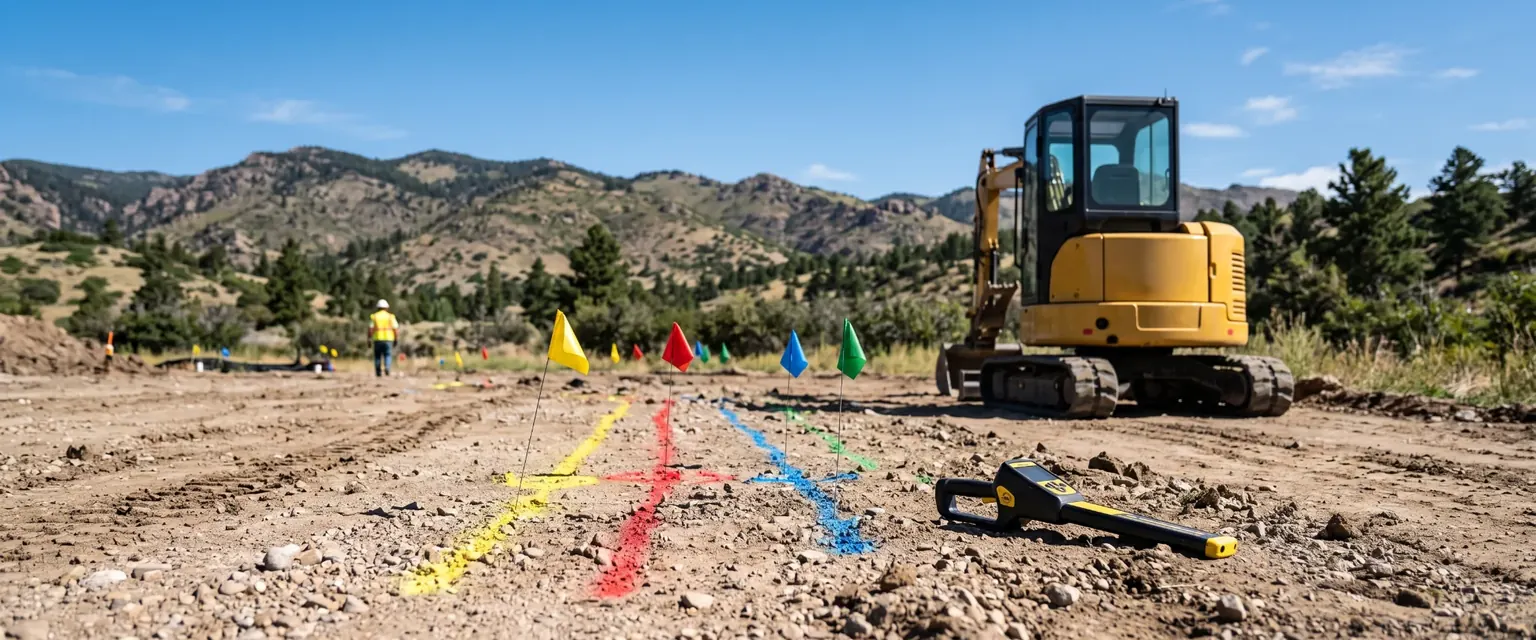
Once people are safe, get your phone out. Photograph the marks, the hole, the tracer wire, and where the line actually sat relative to the paint, with a tape in the frame. Photograph the ticket number on your phone or the paper. Do this before the utility crew arrives and starts digging, because their repair erases the evidence you need.
Then call us. Not the next morning. The utility’s claims department will have a file open before you’re off the site, and your carrier should hear about it from you first.
Who pays: the four ways it goes
Colorado’s excavation statute sorts strikes into a few boxes, and which box you’re in is mostly decided before the bucket goes in.
| What happened | Who the law points at | What your policy does |
|---|---|---|
| Valid ticket, accurate marks, you dug into them with the machine | You | GL typically responds to the repair, the utility’s costs, and third-party claims |
| Valid ticket, marks were wrong or missing | The facility owner is presumed liable and must defend you | GL responds if the presumption gets rebutted; otherwise your defense is on the owner |
| Valid ticket, owner never marked within the statutory window and you proceeded with care | You are not liable unless they prove lack of reasonable care | GL sits behind you if they try |
| No ticket, or an expired one | You are presumed liable for repair, their legal costs, and any resulting damage | GL is read closely; fines and penalties are on you |
The presumption is the whole story. Under C.R.S. 9-1.5-104.5(2)(d), a contractor who damages an underground facility after failing to notify Colorado 811, or failing to use reasonable care, is presumed liable for the owner's repair or replacement costs, litigation costs and attorney fees, and any resulting injury or property damage. (C.R.S. 9-1.5-104.5(2)(d)) “Presumed” is not the same as “strictly liable.” You can rebut it. But you are the one rebutting, in a room where the utility has already sent an invoice, and the burden is a heavy thing to carry without a ticket.
The mirror rule is your friend. The same section runs the other way: an owner who fails to mark with reasonable care after a valid notice is presumed liable, and has to indemnify and defend you. That’s why the photos of the marks matter more than anything else you own on the day of a strike. If the paint said one place and the pipe was somewhere else, the presumption moves to them.
The ticket has to be alive. Colorado law requires notice to Colorado 811 at least two business days before excavating, not counting the day you call (C.R.S. 9-1.5-103(3)(b)); Colorado 811 phrases the same window as three full business days, so a Monday call means a Thursday dig. (C.R.S. 9-1.5-103(3)(b)) And the marks have a shelf life. Locate markings stay valid while clearly visible, but for no more than thirty calendar days after the locate request due date (C.R.S. 9-1.5-103). (C.R.S. 9-1.5-103) A ticket from a job that got rained out in May and restarted in June is not a valid ticket. The Colorado 811 article walks through the dates and the part contractors get wrong.
The bills that arrive, in order
A gas strike produces more than one invoice, and they come from different directions.
- The utility’s repair. The crew, the truck, the pipe, the overtime. This is the first invoice and often the smallest.
- The utility’s other costs. Gas lost, service restoration, customer notifications, and on a bad day the fire department’s bill. Some utilities add their legal costs, and the statute lets them when the presumption sits on you.
- Third parties. An evacuated block in Colorado Springs is a row of businesses that lost a day and a row of homes that had to leave. A restaurant’s lost lunch is a claim. An injury is a bigger one.
- Fines and penalties. Two separate systems. SB 18-167 (2018) created the Underground Damage Prevention Safety Commission (C.R.S. 9-1.5-104.2), whose maximum fines under C.R.S. 9-1.5-104.4(3) run from $250 for a first minor violation to $75,000 for a fourth or later major violation within twelve months. (C.R.S. 9-1.5-104.2; 9-1.5-104.4(3); SB 18-167) And on top of that, Separately from commission fines, C.R.S. 9-1.5-104.5 lets an owner, operator, excavator, aggrieved party, district attorney, or the attorney general sue for civil penalties: $200 for excavating without notice, and $5,000 for a first offense (up to $25,000 for later ones, and up to $75,000 after more than three in twelve months) when that failure damages a facility. (C.R.S. 9-1.5-104.5(2)(b), (2)(c), (3)) Neither one is insurable under most standard forms.
The first two are usually covered as property damage under a general liability policy written for excavation. The third is bodily injury and property damage to third parties, the reason the policy exists. The fourth is yours.
What your policy has to say
Three things, and you can check two of them on your own dec pages tonight.
The XCU line. Explosion, collapse, underground. Some general liability forms exclude all three by endorsement, and a gas strike is an underground property damage claim with an explosion risk attached. On a form with that exclusion, the carrier’s first letter after your strike is a reservation of rights, and the second one is a denial. The exclusion doesn’t show on the dec page; it’s on the endorsement schedule. The XCU article explains where to find it. We look for a dig GL written without it, and we tell you if the form carries it.
The limits. A service line in a subdivision is usually inside a $1M occurrence limit. An evacuation with injuries is not always. That’s what an umbrella is for, and it’s why utility primes and municipalities ask for one on utility trenching work.
The conditions. Every liability policy has a notice condition, and late notice is a real reason for a carrier to push back. Report the strike the day it happens, even a small one you plan to pay yourself. Reporting is not the same as filing a claim. It just puts the carrier on the record.
What the policy typically does not do: pay the fines, pay for your own damaged machine (that’s the equipment policy), or cover damage to your own work. The policy language controls, and the carrier’s read of the utility’s invoice is one thing we don’t control.
The private lines nobody marks
Here’s the part that surprises people above 9,000 feet. Colorado 811 gets the utility’s own facilities marked. The propane line from a tank to a cabin, the water line from the well, the power to the shed: those belong to the owner, and under most locate practice nobody marks them for you. Ask the owner where they run. Then probe by hand before the bucket goes in. On a septic set outside Fairplay, the line you hit is far more likely to be the owner’s propane than the gas main.
Where to go from here
If you dig for a living and you haven’t read your own endorsement schedule, do it before the next ticket. Send the dec pages through the policy review and we’ll mark the XCU line, the limits, and the notice condition against the work you actually do. Starting fresh? Get Insured lists what to have ready. And if you hit something today, call. That’s the one we answer first.
Serving businesses located in Colorado. Coverage is determined by the policy language and the carrier.
If I hit a gas line with a valid locate ticket, do I still pay?
Does general liability cover hitting a gas line?
What should I do in the first minutes after a gas strike?
Are the fines covered by insurance?
Sources
- C.R.S. 9-1.5-104.5, Civil penalties and presumed liability (Colorado Excavation Requirements) (accessed 2026-09-02)
- C.R.S. 9-1.5-103, Notice of excavation and marking of underground facilities (accessed 2026-09-02)
- C.R.S. 9-1.5-104.4, Underground Damage Prevention Safety Commission fines (accessed 2026-09-02)
- Colorado 811 (accessed 2026-09-02)
Related articles
Read next
-
 Colorado law · 8 min read
 Colorado 811: the two-business-day rule, the fines, and the part contractors get wrong
Colorado 811 for contractors: the statute says two business days, 811 says three, marks last 30 days, fines run $250 to $75,000. The part people get wrong. Read the article - Coverage explained · 7 min read
XCU: the three letters that decide whether your GL works on a dig
What XCU coverage is: explosion, collapse, and underground damage, why some GL forms exclude all three, where the line hides, and what it means on a dig. Read the article
Statutes and numbers on this page last verified September 2, 2026 by a licensed Colorado producer. How we verify.