Resources · Colorado law
Colorado 811: the two-business-day rule, the fines, and the part contractors get wrong
The honest answer is that most contractors know the three-day rule and still get burned by it, because the rule they know is not the part of the law that bites. The waiting period is easy. What gets people is the thirty-day clock on the marks, the two separate fine systems that sit on top of the repair bill, and one sentence in the statute that decides who pays before anyone looks at the pipe. We insure excavation contractors statewide and we dig for a living in Park County, so here is the whole thing, with the statute linked.
Two business days or three?
Both, and it’s worth knowing why the numbers differ. Colorado law requires notice to Colorado 811 at least two business days before excavating, not counting the day you call (C.R.S. 9-1.5-103(3)(b)); Colorado 811 phrases the same window as three full business days, so a Monday call means a Thursday dig. (C.R.S. 9-1.5-103(3)(b))
The statute counts two business days and excludes the day you call. Colorado 811 counts the day you call and says three. Same window, two ways of describing it. Call Monday morning, dig Thursday. Call Friday, and the weekend doesn’t count, so you’re looking at Wednesday. A holiday in the middle pushes it another day.
The part contractors get wrong here is small but expensive: business days follow the calendar, not your crew’s schedule. The statute doesn’t spell it out for a crew that works weekends, but our read is that a Saturday you work still doesn’t count toward the two days.
The marks have a shelf life
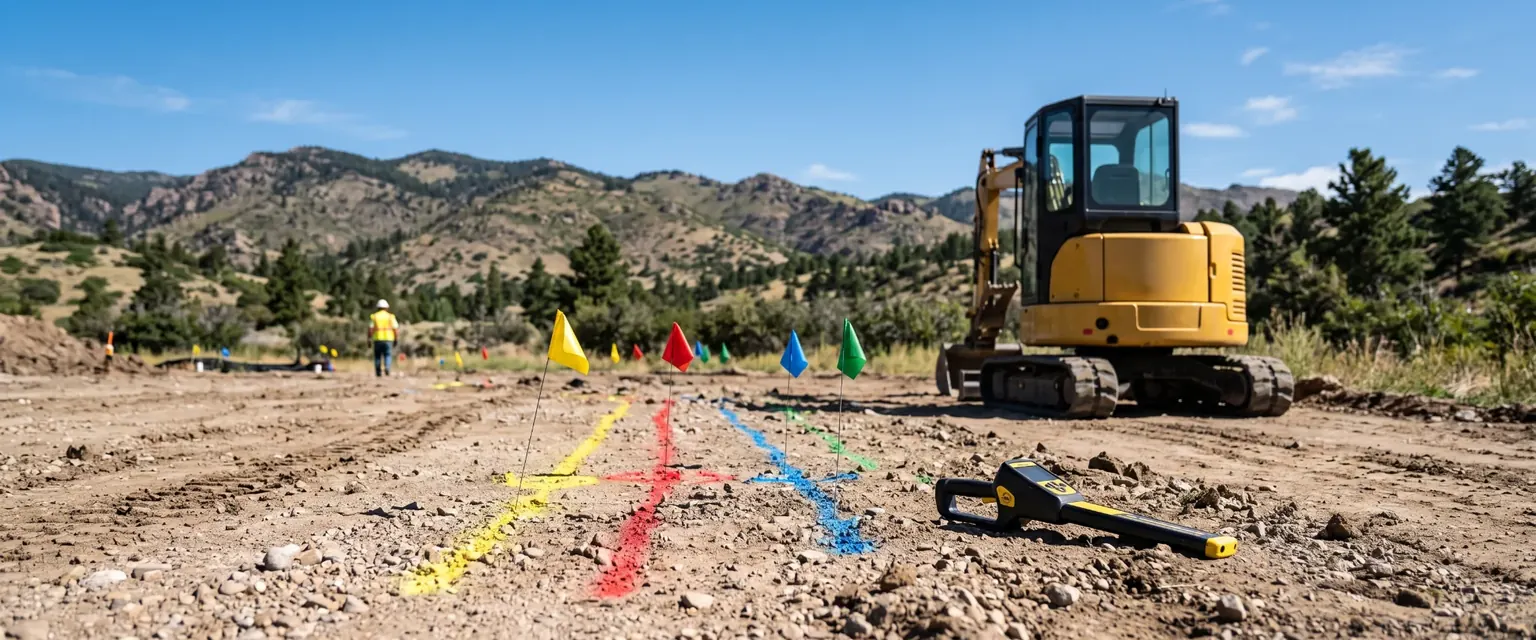
Locate markings stay valid while clearly visible, but for no more than thirty calendar days after the locate request due date (C.R.S. 9-1.5-103). (C.R.S. 9-1.5-103)Thirty days is the outside limit. The real limit is whether you can see the paint. One hailstorm on a Colorado Springs curb line, a week of delivery trucks in a Denver alley, or a wet spring on a Bailey driveway takes the marks off well before the calendar does. When the marks are gone, so is the protection the ticket gave you. Re-call. It costs a day. A strike on faded paint costs a great deal more, and the presumption below is waiting for you.
Rain delays are where this catches people. A ticket pulled for a job that started in May, got rained out, and restarted in June is not a valid ticket anymore, no matter what the paint looks like.
The fines: two systems, not one
Here’s the part that changed in 2018. SB 18-167 (2018) created the Underground Damage Prevention Safety Commission (C.R.S. 9-1.5-104.2), whose maximum fines under C.R.S. 9-1.5-104.4(3) run from $250 for a first minor violation to $75,000 for a fourth or later major violation within twelve months. (C.R.S. 9-1.5-104.2; 9-1.5-104.4(3); SB 18-167)
The commission’s fine schedule runs on how many violations you’ve had in the prior twelve months and how serious the commission calls each one:
| Violation class | 1st | 2nd | 3rd | 4th and later |
|---|---|---|---|---|
| Minor | $250 | $500 | $1,000 | $5,000 |
| Moderate | $1,000 | $2,500 | $5,000 | $25,000 |
| Major | $5,000 | $25,000 | $50,000 | $75,000 |
A few things about that table. The fines apply to anyone who violates the article, which includes the utilities and locators, not just the guy with the excavator. A fine requires a unanimous vote of the commission’s review committee. And homeowners and ranch or farm owners digging on their own property are exempt, which you are not.
The second system is older and separate. Separately from commission fines, C.R.S. 9-1.5-104.5 lets an owner, operator, excavator, aggrieved party, district attorney, or the attorney general sue for civil penalties: $200 for excavating without notice, and $5,000 for a first offense (up to $25,000 for later ones, and up to $75,000 after more than three in twelve months) when that failure damages a facility. (C.R.S. 9-1.5-104.5(2)(b), (2)(c), (3)) This one isn’t a commission action. It’s a lawsuit, and the penalty goes to whoever wins it. The utility whose main you cut can bring it. So can the district attorney.
Neither fine is insurable under most standard forms. A general liability policy typically responds to the damage you caused. It does not pay the penalty for causing it.
The sentence that decides who pays
This is the part contractors get wrong most, and it costs more than any fine. Under C.R.S. 9-1.5-104.5(2)(d), a contractor who damages an underground facility after failing to notify Colorado 811, or failing to use reasonable care, is presumed liable for the owner's repair or replacement costs, litigation costs and attorney fees, and any resulting injury or property damage. (C.R.S. 9-1.5-104.5(2)(d))
Read that once more. Dig without a valid ticket, or with a valid ticket but without reasonable care, and the law starts from the assumption that the repair, the utility’s attorney fees, and whatever the strike did to the block are all yours. You can argue against the presumption. You are the one arguing.
The statute also runs the other direction, and this is the half worth memorizing. An owner who fails to mark with reasonable care after a valid notice is presumed liable and has to defend you. And if the owner doesn’t mark within the statutory window at all, you may proceed, and you’re not liable unless they prove you lacked reasonable care. A valid ticket doesn’t just start the clock. It moves the presumption off your back and onto theirs, which is why the ticket record and the photos of the marks are the most valuable paper you own. The gas strike article walks through how that plays in a claim.
Colorado Springs, and the cities with their own rules
Colorado Springs City Code § 12.10.104 requires anyone planning an excavation to identify the dig area when calling 811, by pre-marking it with white paint, flags, or stakes, or by providing an electronic map or aerial delineation; utility owners may decline to locate until an unclear area is pre-marked. (Colorado Springs City Code §§ 12.10.101, 12.10.104, 12.10.106 (Ord. 20-70; Ord. 24-09)) In Colorado Springs, white paint or an electronic map is part of the ticket, not a courtesy, and a locator can refuse an unclear area until you do it. Other cities write their own excavation and right-of-way ordinances on top of the state statute. Denver requires a street occupancy permit on top of the street cut permit. Ask the city before you bid outside your usual county, and ask whether their rule adds to the state clock.
What the ticket does for your insurance
Two things.
First, the carrier reads loss runs the way the statute reads a strike. A hit with a valid ticket, fresh marks, and photos showing the pipe two feet off the paint is a claim your carrier defends with the mirror rule in hand. A hit with no ticket is a claim the carrier reads very hard, and it follows you to every renewal for years.
Second, the policy has to be the right one. Underground damage is excluded on some GL forms by endorsement. The XCU article explains the three letters and where to find the line. For utility trenching or any crew that opens ground near gas, we look for a GL form without that exclusion and tell you if the carrier’s form carries it, and on the bigger public work an umbrella sits over the top, because an evacuation is not a $1M event.
A locate checklist that holds up in a claim
- The ticket number, the date called, and the due date, on the job folder and on your phone.
- Dated photos of every mark with a tape measure in the frame, taken before the bucket goes in.
- A note of what was not marked. If a utility you expected didn’t show, call it in as a no-response before you dig.
- The owner’s answer, in writing if you can get it, on where the private lines run. Propane, well lines, and power to the shed are not on the ticket.
- A calendar entry for the thirty-day mark.
- The re-call number, if the marks faded or the job stalled.
Where to go from here
If you open ground in Colorado, your policy has to be built around the locate rule, not just around the trade. Get Insured lists what to have ready, including the questions we ask about your ticket practice. Already covered? Send the dec pages to the policy review and we’ll find the underground exclusion if it’s there. No online quote, on purpose.
Serving businesses located in Colorado. Coverage is determined by the policy language and the carrier.
Is the Colorado 811 rule two business days or three?
How long are 811 locate marks valid in Colorado?
What are the fines for digging without calling 811 in Colorado?
Does my general liability policy pay the 811 fines?
Does Colorado Springs have extra locate rules?
Sources
- C.R.S. 9-1.5-103, Notice of excavation and marking of underground facilities (accessed 2026-09-02)
- C.R.S. 9-1.5-104.2, Underground Damage Prevention Safety Commission (accessed 2026-09-02)
- C.R.S. 9-1.5-104.4, Safety commission enforcement and fines (accessed 2026-09-02)
- C.R.S. 9-1.5-104.5, Civil penalties and presumed liability (accessed 2026-09-02)
- Senate Bill 18-167, signed act (Colorado General Assembly) (accessed 2026-09-02)
- Colorado 811 (accessed 2026-09-02)
- Colorado Springs City Code § 12.10.104, Identification of excavation site (accessed 2026-09-02)
Related articles
Read next
- Excavation · 7 min read
You hit a gas line. Here's who pays, and what your policy has to say about it
Hit a gas line while digging in Colorado? Who pays depends on your locate ticket, the marks, C.R.S. 9-1.5, and the XCU line in your GL. How the claim unfolds. Read the article - Coverage explained · 7 min read
XCU: the three letters that decide whether your GL works on a dig
What XCU coverage is: explosion, collapse, and underground damage, why some GL forms exclude all three, where the line hides, and what it means on a dig. Read the article
Statutes and numbers on this page last verified September 2, 2026 by a licensed Colorado producer. How we verify.