LANDSCAPING TRADE
Hardscape and Paver Installer Insurance in Colorado
A retaining wall is the one thing a landscaper builds that can hurt somebody three years after the final payment. Pavers heave, walls lean, and the block stacked on the driveway belongs to you until the owner signs. Here's what a hardscape outfit's policy has to do in Colorado.
Hardscape is landscaping with a structural tail. A lawn crew’s worst day is a rock through a window. Yours is a wall you built in expansive clay letting go three years later with a neighbor’s patio on top of it. The claim comes to whoever’s name is on the invoice, from a policy year that closed. We build walls and set boulders on our own dirt jobs in Park County, so we’ve stood on both sides of this. This page sits under our landscaping hub; if you also run pipe, the irrigation page covers the water side.
What the underwriter sees on a hardscape application
Walls, and how tall.
Every underwriter who has paid a retaining wall claim asks the same three questions. What’s the tallest wall you build, who designs it, and do you pull permits. Knee-high garden borders and paver patios typically rate as landscape gardening. Six-foot segmental walls holding up driveways are closer to a structural risk, and they rate that way whether or not the class code changes.
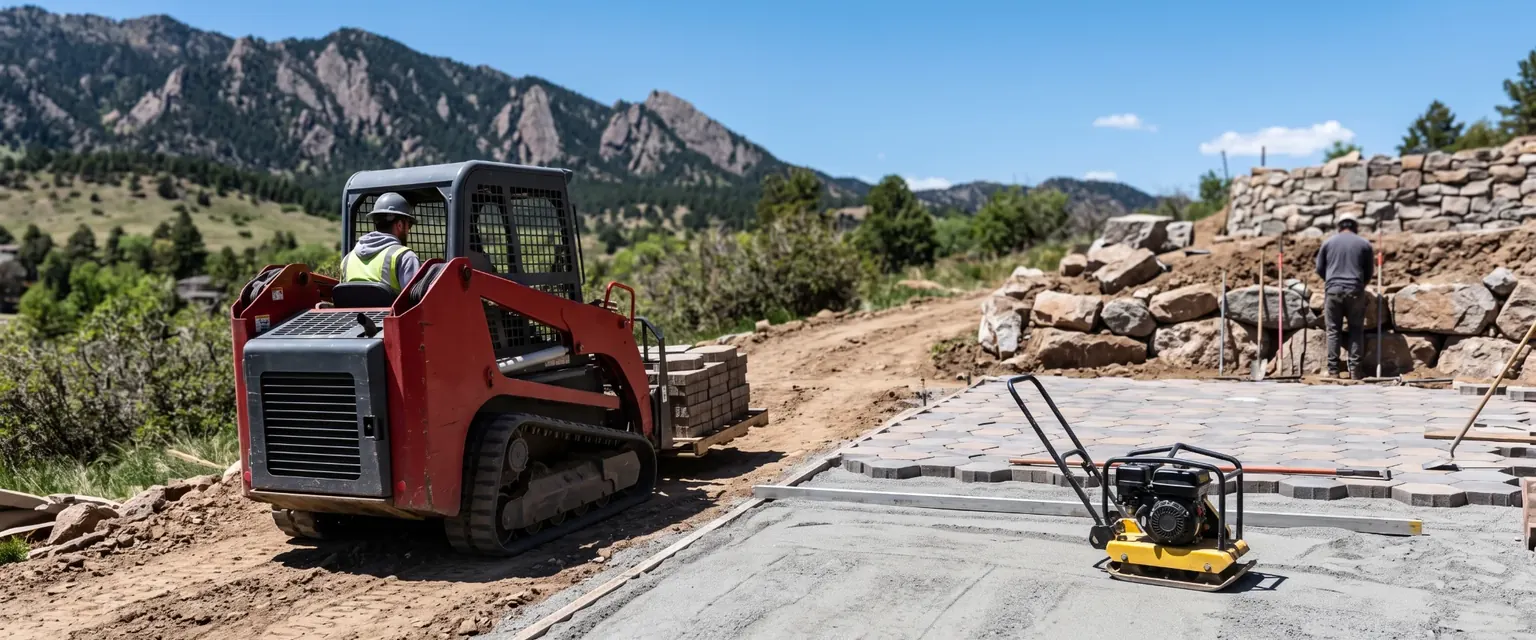
Then the materials. Pavers, block, caps, boulders, and base rock stacked on a customer’s driveway for a week or two on every job. That’s your property, uninsured under GL and under most equipment forms, so the underwriter asks how much sits out at once. Then the machines (a Yanmar mini skid steer, a mini excavator, a plate compactor, a wet saw) and the revenue mix between walls, patios, planting, and winter plowing.
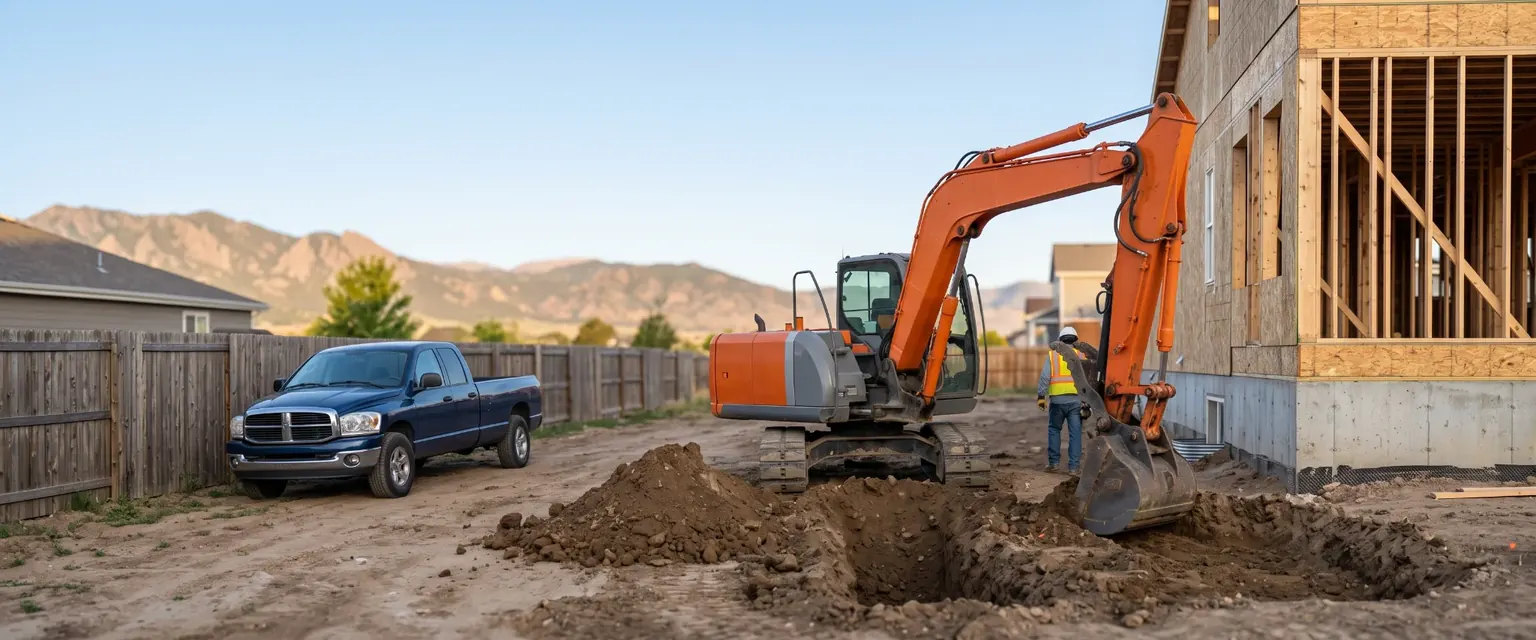
Colorado adds expansive clay on the Front Range. It swells when it’s wet, shrinks when it’s dry, and pushes on anything you built into it. Freeze-thaw does the rest. A wall with no drainage behind it in Castle Rock or Parker is a hydraulic press waiting for a wet spring. Hail wrecks cap stone on the pallet. Underwriters read all of it as completed-operations risk and materials risk.
The five exposures that produce hardscape claims
- The wall moves. A segmental block wall you built on a Castle Rock slope in expansive clay goes up without enough drain rock behind it. Two springs of freeze-thaw later it leans, then it lets go onto the neighbor’s patio. That is a completed-operations claim on a policy year that already closed.
- The patio heaves. A paver patio in Aurora settles and heaves in the second winter because the base was compacted in one lift over wet clay. Re-laying your own pavers is your warranty, typically excluded; the water it sent into the crawl space is the resulting damage GL commonly does cover.
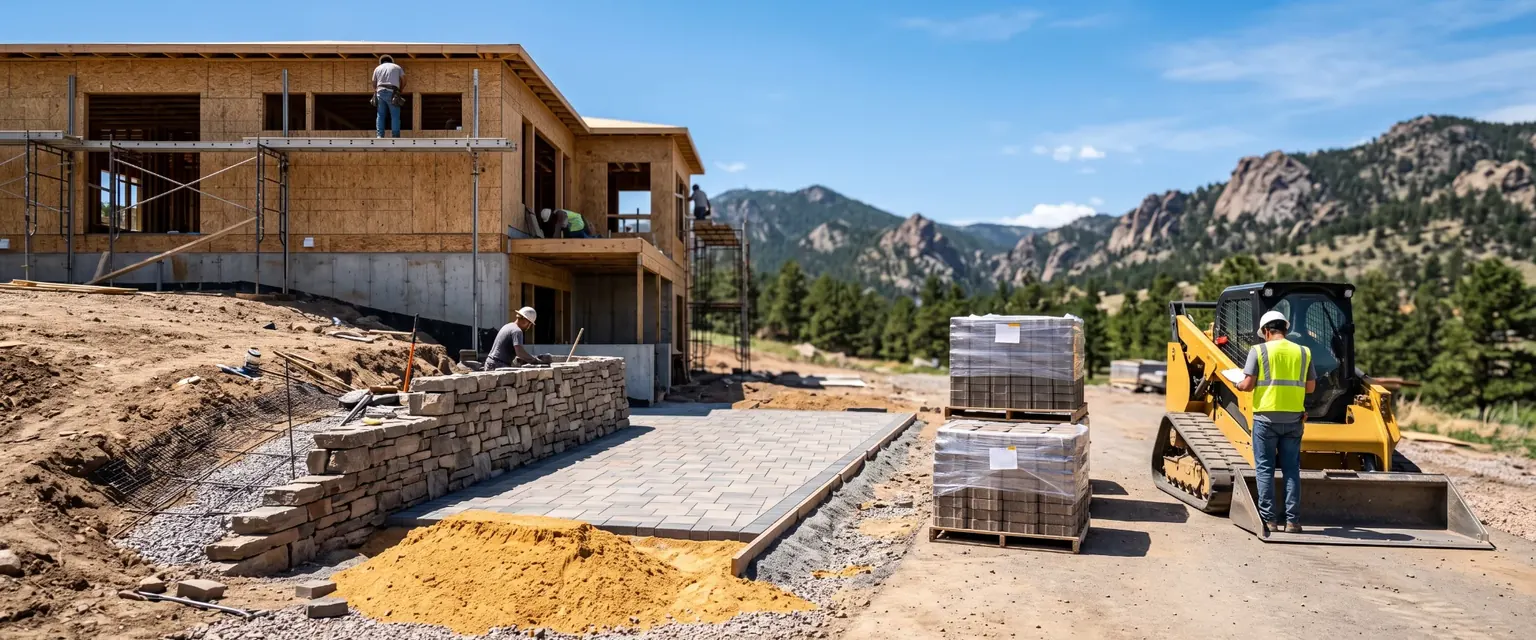
- Materials on site. Four pallets of pavers and two of wall block sit on a Loveland driveway for a week while the base goes in. A hailstorm cracks the caps and a trailer backs up to the rest on Saturday night. Your GL and your equipment policy both say no. An installation floater says yes.
- Boulder placement. A Yanmar mini skid steer setting a 1,200-pound boulder on a Douglas County slope loses the load on a wet morning, and the boulder rolls through the neighbor’s fence and a parked car. GL for the fence and the car, inland marine for the machine if it went over too.
- Crew injury and utilities. A laborer in Fort Collins cutting block with a wet saw takes a chip in the eye, and the mini excavator opening the wall footing finds the gas service on the same afternoon. Workers’ comp for the first, GL and the 811 rules for the second.
Walls settle and hail comes in June. The stack below is built so each of those has a policy standing behind it.
The coverage stack we’d build
| Coverage | Why | Typical contract requirement |
|---|---|---|
| General liability, occurrence form, completed operations included, no residential or “subsidence” exclusion | The wall on the neighbor’s patio, the boulder through the fence, the water in the crawl space. During the job and for years after. | $1M per occurrence / $2M aggregate; builder or HOA as additional insured on completed operations |
| Installation floater | Pavers, block, caps, boulders, and base on site, in the trailer, and in the yard. Hail, theft, a wall knocked down mid-build. Until the owner accepts. | Sometimes on commercial installs; usually a business decision on residential |
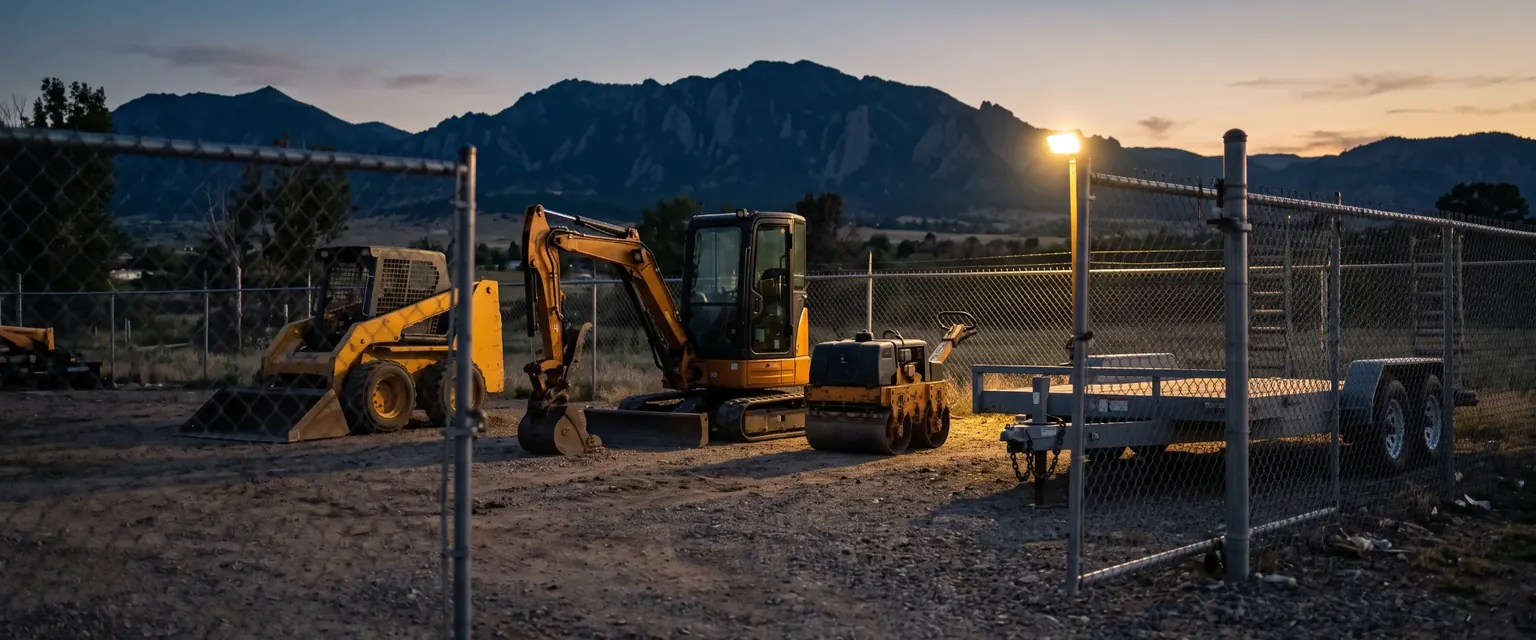
| Contractors equipment (inland marine) | The mini skid steer, mini excavator, compactor, saws. Rollover on a slope, theft off a driveway, transit. | Your lender, not your customer |
| Workers’ compensation | Saw cuts, lifting, and a block on a foot. Required at the first employee. | Statutory; waiver of subrogation on builder and HOA work |
| Commercial auto | The one-ton pulling the skid steer and the dump trailer of base rock. Personal auto forms commonly exclude business use. | $1M combined single limit on any contract with an insurance section |
| Umbrella / excess | A wall failure that takes a house’s foundation with it can pass $1M. | Occasionally on commercial and HOA work; worth pricing if you build tall walls |
The line that bites is the “your work” exclusion. Under most standard GL forms, the cost of fixing or replacing your own defective work is excluded. The wall you rebuild is on you. Still covered on a clean occurrence form: what the failed wall did to other people and their property, and the defense, subject to limits. So a hardscape GL claim is almost always an argument about which pile of damage is “your work” and which is “resulting damage.” The pavers are yours; the flooded basement is theirs. Some carriers add a residential, subsidence, or earth-movement exclusion that cuts the resulting-damage side too. Those are the pages to read.
Contract requirements you’ll run into
Most hardscape work is direct to the homeowner and light on paper. The paper shows up when the customer isn’t a person:
- Builders. The GC’s subcontract: $1M/$2M GL, additional insured on ongoing and completed operations, primary and non-contributory, waiver of subrogation. The completed-operations half matters more to you than to the painter.
- HOAs and property managers. A certificate at $1M/$2M with the association as additional insured. Common walls and entry monuments are where HOA hardscape claims come from.
- Commercial and public work. Higher limits, an umbrella, an installation floater at a stated per-project limit, and a bond. Our bonds page explains why surety is not insurance.
- Engineered walls. When a wall gets a stamp, the contract may try to push design responsibility onto you. Installing to a design is not the same as owning the design.
Colorado notes for hardscape installers
No state license, a lot of city rules. Colorado has no state landscape-contractor license (DORA licenses landscape architects only); landscapers answer instead to local business-license, right-of-way, and trade-permit rules that vary by city, and most Front Range building departments do not issue a landscape-specific contractor license. (DORA Division of Professions and Occupations program list; City of Aurora and Denver contractor class lists) Building permits for walls, right-of-way permits at the curb, and business licenses all live at the city or county. Douglas County, Aurora, and Fort Collins and Loveland each ask for something different. Call the building department before you bid across a line you haven’t worked.
Engineering thresholds. Above a height the building department sets, a retaining wall commonly needs an engineer’s design and a permit, and a wall holding back a surcharge (a driveway, a structure, a slope above it) can need one lower than that. We don’t quote the number because it varies by jurisdiction. The building department is the source. An unpermitted wall that needed a stamp is the first thing an adjuster looks for.
The locate rule applies to footings. Colorado law requires notice to Colorado 811 at least two business days before excavating, not counting the day you call (C.R.S. 9-1.5-103(3)(b)); Colorado 811 phrases the same window as three full business days, so a Monday call means a Thursday dig. (C.R.S. 9-1.5-103(3)(b)) A wall footing is an excavation. So is a patio base cut in front of a house where the gas and electric services come in.
Workers’ comp. Colorado employers must carry workers' compensation insurance as soon as they have one or more employees, whether part-time, full-time, or family members (C.R.S. 8-40-203(1)(b), 8-44-101); the state can fine an uninsured employer up to $500 for every day without coverage. (C.R.S. 8-40-203(1)(b); 8-44-101; 8-43-409) A summer laborer on a wet saw is who the statute was written for.
Class codes. Landscaping contractors are typically rated under NCCI code 0042 (Landscape Gardening & Drivers; lawn maintenance under 9102), excavation under 6217 (Excavation & Drivers), tree work under 0106 (Tree Pruning), and stand-alone snow-clearing under 9402 (Street Cleaning & Drivers); the carrier makes the final assignment under NCCI rules. (NCCI Scopes Manual) [VERIFY] Hardscape payroll typically rides with landscape gardening. Tall structural walls can pull it toward a masonry or excavation code, and the carrier makes that call.
Expansive clay and drainage. Drain rock, a perforated pipe with a daylight outlet, filter fabric, and a base compacted in lifts are what keep a wall standing in Castle Rock clay. None of that is an insurance requirement. All of it is what the adjuster’s engineer will look for.
Where to go from here
Already carry GL? The fastest move is a policy review. Send the dec pages and we’ll mark the completed-operations line, the “your work” exclusion, any subsidence or residential exclusion, and whether there’s any materials coverage on the equipment policy. Starting fresh? Get Insured lists what to have ready: your tallest wall, your biggest staging, and the machine list. No online quote. A hardscape book is built around how many walls are in the ground with your name on them.
Serving businesses located in Colorado. Coverage is determined by the policy language and the carrier.
Coverage
Coverage built for hardscape and paver installer.
-
 Coverage
General liability
Pays when your work hurts someone else or their property. The one every GC asks about first. General liability explained -
 Coverage
Builder's risk and installation floater
Insures the wall, the pavers, and the pipe before the owner accepts them. Your equipment policy doesn't. Builder's risk and installation floater explained -
 Coverage
Contractor's equipment (inland marine)
Insures your own iron: theft, rollover, fire, transit. Pays what you scheduled, so the schedule matters. Contractor's equipment (inland marine) explained
Does general liability cover a retaining wall that fails after I'm done?
Do I need an installation floater for pavers and block?
When does a retaining wall need an engineer in Colorado?
Is there a hardscape contractor license in Colorado?
Statutes and numbers on this page last verified September 2, 2026 by a licensed Colorado producer. How we verify.