Resources · Coverage explained
Reading your own dec page, line by line
The honest answer is that the dec page is the only part of the policy most contractors ever read, and it isn’t the policy. It’s the index. Named insured, dates, limits, classifications, a premium line, and a list of form numbers that are the actual contract. Read it right and it tells you where every problem on the policy lives. Read it like a receipt and it tells you what you paid. This article walks a typical commercial package dec page section by section: what each line says and what to check. Bring your own dec page and your general liability form schedule, because the point is to find your lines, not ours.
The common declarations
The front of the package: one common declarations page, then a section for each line inside it (general liability, property, inland marine). Auto and workers’ comp are usually separate policies with their own decs. The common page is boring, and it’s where the expensive mistakes are.
| Line | What it says | What to check |
|---|---|---|
| Named insured | The legal entity the policy insures | Exact legal name and entity type. An LLC formed last year with a policy still in the sole proprietor’s name is a coverage question on claim day |
| DBA / trade name | Any trade name the entity operates under | Listed, if you bid under one. The name on your contracts should match a name on the policy |
| Policy period | Effective and expiration dates | The dates you think you have, and whether auto, equipment, and comp share them or are staggered |
| Description of operations | A short phrase describing what you do | Describes all of it. “Landscape contractor” on an outfit that trenches and plows is an application problem waiting to be found |
| Coverage parts | Which lines are in the package | Every line you think you carry. A missing inland marine part means the excavator is on nothing |
The named insured line does more damage than any other. Every DBA and every entity that signs a contract needs to be on the policy or added by endorsement. The certificates article explains why a mismatch between the contract name and the policy name is the first thing a holder rejects.
General liability declarations
The section contractors flip to. The limits are the part they read; the rest is where the coverage lives.
| Line | What it says | What to check |
|---|---|---|
| Each occurrence | The most the policy pays for one occurrence | Matches the largest contract ask you sign, commonly $1,000,000 |
| General aggregate | The most the policy pays for all occurrences in the period, other than products-completed operations | Commonly $2,000,000. Some contracts ask that the aggregate apply per project; that’s an endorsement, not a limit |
| Products-completed operations aggregate | A separate pool for claims from finished work | It exists and isn’t zero. Some contractor policies carry an exclusion here instead |
| Classifications | The GL class codes and descriptions of your operations | Every operation you perform is listed. Excavation, landscape install, snow removal, and tree work are separate classifications and a missing one is a missing coverage argument |
| Rating basis and estimate | What premium is calculated on (payroll, receipts, per unit) and your estimate of it | Payroll and receipts get audited. A stale estimate is an audit bill |
| Deductible | Any amount you pay first on a covered claim | Whether it applies to property damage only or to bodily injury too, and per claim or per occurrence |
The classifications line deserves a second look. GL uses its own classification system, separate from workers’ comp. The comp codes for our trades typically fall among 0042, 9102, 6217, 0106, 9402[VERIFY] , and the carrier makes the final call under NCCI rules; that fact carries a verify badge because one code is still being confirmed. The GL codes are different numbers with different descriptions, and the two policies can describe your operation differently in the same year. The class code article covers the comp side. On GL, the question is only whether every kind of work you do is on the list.
The forms and endorsements schedule
Here’s the section that is the policy: a list at the end of each coverage part, with a form number, an edition date, and a title. The coverage form is the base contract. Every endorsement after it changes that contract, and most of the ones that matter to a contractor take something away.
| Line | What it says | What to check |
|---|---|---|
| Coverage form | The base contract, by form number and edition | Which edition. Older editions differ from newer ones in ways that matter, and the number tells you which contract you actually have |
| Additional insured endorsements | Who else gets coverage under your policy and for what | Blanket or scheduled, ongoing operations only or completed operations too. The contract asks decide which you need |
| Primary and non-contributory | Your policy pays first for the additional insured | Present if any contract asks for it, and most commercial ones do |
| Waiver of subrogation | Your carrier gives up recovery against the party named | Blanket or scheduled, and whether the same waiver exists on auto and comp |
| Any form titled “exclusion” | Coverage removed | Every one, looked up by title: explosion, collapse, underground property damage (XCU), earth movement, snow and ice removal, roofing, fungi, pollution, designated work, contractual liability limitations |
| Classification limitation | Coverage applies only to the operations classified on the dec page | If present, the classifications list becomes the boundary of the policy. Anything not listed may be excluded, not just unrated |
| Subcontractor endorsements | Conditions on hiring subs, often requiring certificates and limits from each | Conditions you actually meet. A warranty you can’t keep is a coverage condition you’re already failing |
| Pollution endorsements | Time-element or limited pollution coverage, or a total exclusion | Which one. A total pollution exclusion on a septic or trenching outfit is a real gap |
The rule is simple: read every form with “exclusion” or “limitation” in the title. The XCU article walks the one that matters most in dirt work. The snow and ice exclusion matters to anyone who plows. The subcontractor warranty matters to everyone who hires one. None of them announce themselves. They’re a form number and a short title, and the only way to know what they do is to pull the form.
Commercial auto declarations
On its own policy, usually.
| Line | What it says | What to check |
|---|---|---|
| Covered auto designation | Which vehicles the policy covers, by category: any auto, owned autos only, scheduled autos, hired, non-owned | Whether a truck you bought mid-term is covered automatically or only if scheduled, and whether hired and non-owned is on for the crew’s own trucks |
| Liability limit | Often a combined single limit | Meets the contract asks. 25/50/15 is the state minimum, and contracts commonly ask for $1,000,000 combined single limit instead |
| Schedule of covered autos | Each vehicle by year, make, VIN, and garaging address | Every plated unit and trailer is on it with the right VIN, and the radius is honest. The Mack that hauls on the highway belongs here; the Bell that never leaves the job belongs on the equipment schedule |
| Physical damage | Comprehensive and collision, per vehicle, with deductibles | Which units have comprehensive. The hail article explains why that list matters every June |
Inland marine (contractor’s equipment) declarations
| Line | What it says | What to check |
|---|---|---|
| Scheduled equipment | Each machine by make, model, serial, and value | Every machine you own is on it, every one you sold is off, and the values are current, not from the year you bought them |
| Blanket / unscheduled limit | One pool for small tools and attachments, with a per-item cap | The cap is bigger than your most expensive attachment. A hydraulic hammer over the cap needs its own line |
| Rented or leased equipment | Coverage for machines you rent, with an any-one-item limit | Present, and sized to the biggest machine you actually rent |
| Valuation | Replacement cost or actual cash value | Which one, and whether it’s per item or for the schedule |
| Coinsurance and deductible | A requirement to insure to a percentage of value; the deductible per occurrence or per item | Whether coinsurance applies and at what percentage; how the deductible stacks in a storm that hits four machines |
Workers’ compensation declarations
| Line | What it says | What to check |
|---|---|---|
| Item 1 | Named insured, address, entity type, often the owners or officers | Owners match reality, and their inclusion or exclusion matches the election form on file with the carrier |
| Item 3.A and 3.C | The states where the policy applies, and other-states coverage | Colorado is listed, and any state a crew might work in is in 3.A or 3.C |
| Item 3.B | Employer’s liability limits | Meet the contract asks, which are often higher than the form’s default |
| Item 4 | Classifications, codes, rates, estimated payroll, and premium by class | Every class you work in is listed with a payroll estimate that’s honest. The audit article is what happens to this line |
| Endorsements | Waiver of subrogation, owner inclusion or exclusion, alternate employer | Blanket waiver if contracts ask for it; owner endorsements match the elections you made |
The premium line
Every coverage part ends with a premium. No figures here, but the structure matters. On GL and comp the number is typically a deposit against an estimate, adjusted at audit. On auto and equipment it’s usually flat for the term. Many policies also carry a minimum premium the carrier keeps regardless of how the audit comes out, and a mid-term cancellation may be short-rated, returning less than the unused fraction. If you’re planning to cancel in the fall and rebind in spring, those two terms are the ones to find first.
The one-hour version
- Named insured. Matches the entity that signs contracts, with every DBA listed.
- Description of operations and classifications. Every kind of work you actually do, on GL and on comp.
- Forms schedule. Every form with exclusion or limitation in the title, looked up and read.
- Equipment values and covered autos. The schedule matches the yard; the VIN list matches the plates.
- Additional insured, primary, and waiver endorsements. Present in the form your contracts ask for.
A hardscape crew in Boulder County with a mini excavator, a plate compactor, and two trucks can do that in an hour. Then send it with the loss runs, and the review starts from what’s on the policy rather than what anyone remembers buying.
Where to go from here
Send us the dec pages for every policy you carry, forms schedules included. A policy review starts with the lines above and ends with a list of which forms take coverage away and what it would take to change them. The excavation insurance hub covers how the package fits together for a dirt outfit, and the commercial auto page covers the truck policy most contractors read least.
Serving businesses located in Colorado. Coverage is determined by the policy language and the carrier.
What is a declarations page?
Where is the XCU exclusion on my dec page?
Why does my GL dec page show a class code that isn't my workers' comp code?
What does 'rating basis: payroll' mean on my dec page?
Sources
- C.R.S. 10-4-620, Required coverages (minimum auto liability limits) (accessed 2026-09-03)
- NCCI, Classification Scopes overview (II_FYI-CW-2017-11) (accessed 2026-09-03)
Related articles
Read next
- Coverage explained · 7 min read
XCU: the three letters that decide whether your GL works on a dig
What XCU coverage is: explosion, collapse, and underground damage, why some GL forms exclude all three, where the line hides, and what it means on a dig. Read the article - Coverage explained · 9 min read
Class code 0042 and friends: how your crew gets rated
Workers comp class code 0042 and landscape gardening. How the governing class, payroll splits, standard exceptions, and plow season set what your crew costs. Read the article - Contracts and COIs · 9 min read
Certificates in under a day: what has to already be true
A fast certificate of insurance is preparation, not speed: the endorsements that have to already be on the policy, the holder list, and a complete request. Read the article - Claims · 9 min read
How your claims history follows you: loss runs, explained
A loss run is the report every underwriter reads before quoting you. What's on it, open reserves vs paid, the experience mod, and how to get yours. Read the article -
 Claims · 9 min read
 Colorado hail and your equipment yard
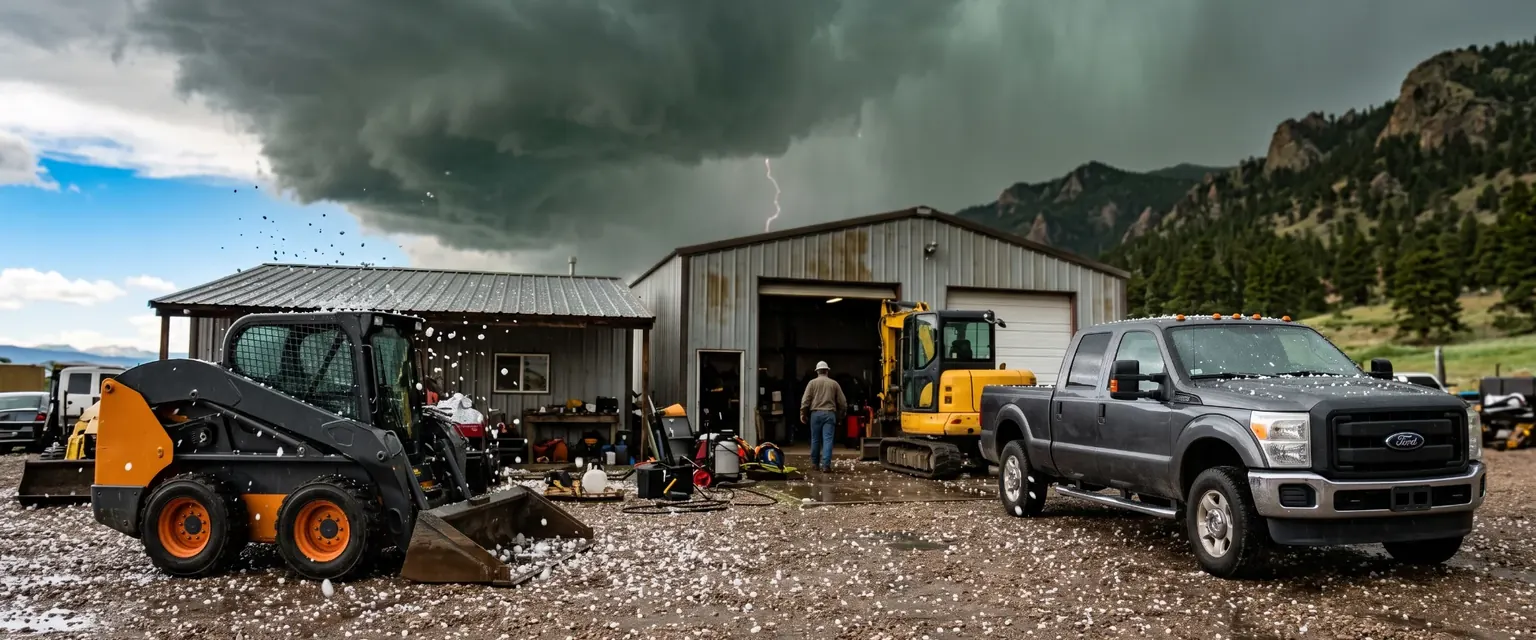
Hail hits the yard, not the job. Which policy pays for the dump truck, the grader cab glass, and the shop roof, how deductibles stack, and what to photograph. Read the article
Statutes and numbers on this page last verified September 2, 2026 by a licensed Colorado producer. How we verify.