Resources · Claims
Colorado hail and your equipment yard
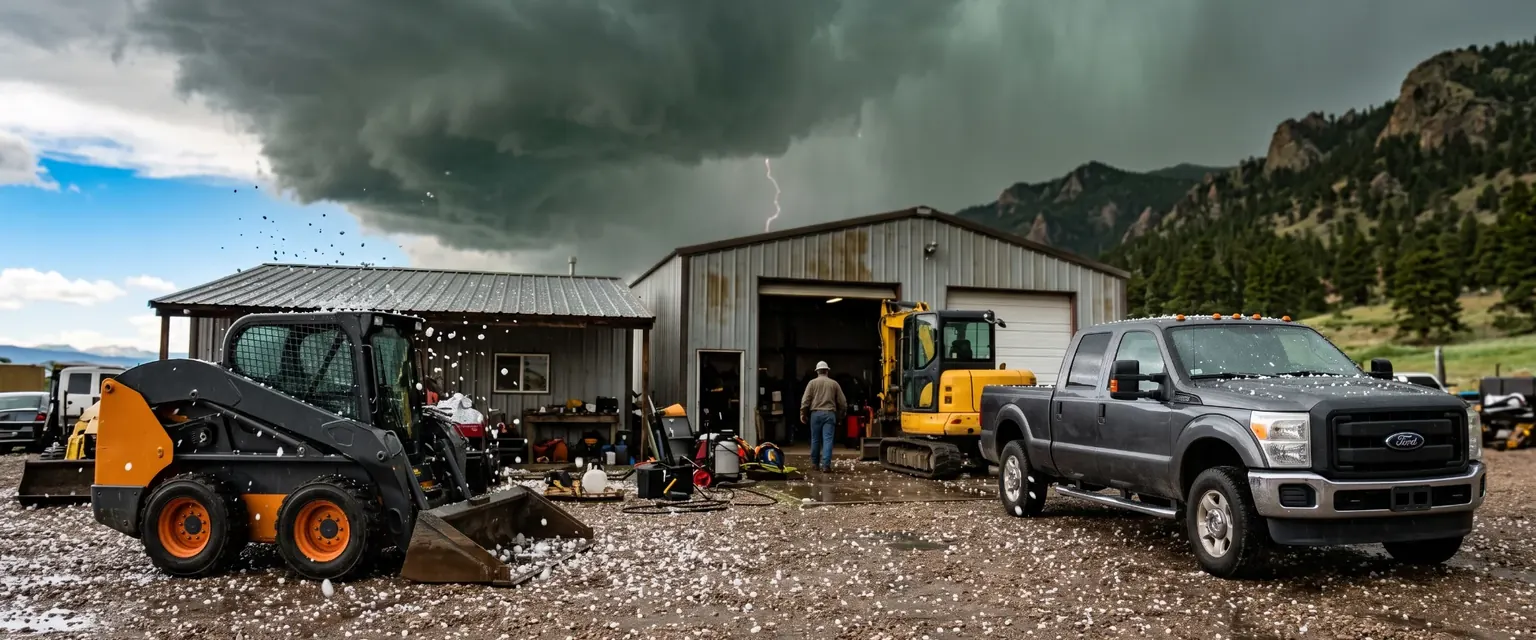
The honest answer is that hail is a yard claim, not a job claim, and most contractors have their policies set up for the job. The storm doesn’t find the excavator on a Weld County site. It finds everything parked in a row behind the shop on a Tuesday evening in June: the Mack dump truck, the mower trailer, the plow truck that’s been sitting since March, the John Deere 772GP with the glass cab, the skid steer with the door open. Each of those is on a different policy, or on none, and each one has its own deductible. Here’s what the commercial auto and equipment policies typically do with hail, where the gaps are, and what to have on file before mid-April.
The season, and why the yard matters
Colorado’s hail is a Front Range and plains problem more than a mountain one, and it has a calendar.
The Rocky Mountain Insurance Information Association puts Colorado's damaging hail season at mid-April to mid-September and lists the May 8, 2017 Denver metro hailstorm at $2.3 billion in insured losses, the costliest hail event in the state's record. (RMIIA, Hail (catastrophes and statistics))That figure is an industry association’s number for one storm, and as we read the source it’s the record as of that page rather than a current ranking, so take it as scale, not as a standing. The point for a contractor is simpler. For five months the yard is exposed every afternoon, and the yard is where the fleet is densest. A job site has one machine on it. The yard in Greeley has all of them, parked close, cabs facing the same way, with nothing overhead.
That’s also why hail is expensive in a way a single rollover isn’t: it’s a lot of moderate damage across a lot of units, each with its own deductible, at the exact time of year the machines need to be working.
Which policy has which machine
Three policies show up in a hail claim, and one that doesn’t.
Commercial auto has the plated trucks, and it pays for hail only under comprehensive physical damage, bought per vehicle. Liability-only units get nothing. On most fleets the tractor and the newer three-quarter-tons have comprehensive because the lender wanted it, and the older units, the mower trailer, and the plow truck that only works in winter are carried liability-only to save premium. The storm doesn’t know which is which.
Contractor’s equipment (inland marine) has the unplated iron: the excavator, the skid steer, the grader, the roller, attachments under the blanket. Under most standard forms hail is a covered peril, subject to the deductible, and some forms carry a specific wind and hail exclusion or a higher weather deductible, which is worth ten minutes to find. The equipment page covers the schedule; the schedule-values article covers why the value on it decides what a claim pays. A grader with a shattered cab and a dented hood pays to the scheduled value less the deductible, and a 2019 value on a 2026 claim is a problem in hail the same way it is in a fire.
Commercial property or a BOP has the shop: the roof, the skylights, the overhead doors, the parts on the shelves, the office computers. Wind and hail on a building often carry a separate deductible, sometimes expressed as a percentage of the building limit rather than a flat number, and some forms limit or exclude cosmetic damage to metal roofing. Read the property page and then your own form. A dented steel roof that still sheds water may be a cosmetic loss on some forms and a full roof on others.
General liability does nothing here. It’s for damage you do to other people. Your own stuff, in your own yard, isn’t a GL claim under standard forms, and a lot of claim calls after a storm start with someone assuming otherwise.
Cab glass, lights, and the parts that add up
On a truck, hail damage is dents on the hood, roof, and bed rails, and broken glass. On a machine it’s the same plus a longer list: cab glass on all sides, LED work lights, mirrors, the operator’s seat if the door was open, hydraulic hoses if the hail was big enough, and the sheet metal on the hood and side panels. Paint chips on a machine matter less than on a truck, and adjusters tend to price them that way.
Glass is the piece to understand. Some auto policies handle glass under a separate, lower deductible or a glass endorsement. Equipment policies generally don’t, so a cracked grader windshield is the full equipment deductible. On a fleet where every machine got a windshield, that’s the whole deductible on each, and the repairs are small enough that the deductible eats most of them. That isn’t a reason to skip the claim. It’s a reason to know the deductible before deciding.
Deductibles as a concept
We won’t put numbers here because yours are on your dec page and they’re not ours to guess. What matters is how they apply.
On auto, the deductible is typically per vehicle, per occurrence. Six trucks with comprehensive in one storm is six deductibles. On the equipment policy, the deductible is typically per occurrence, so four machines in one storm may be one deductible, or per item, depending on the form. On property, wind and hail may carry their own deductible, higher than the all-other-perils number, and if it’s a percentage of the building limit it can be larger than you’d think on a decent shop.
Two things follow. First, a higher comprehensive deductible on the trucks lowers premium every year and shows up all at once in one storm; that’s a real tradeoff, not a mistake, and it’s fine as long as it’s chosen. Second, if a storm damages five units and the deductibles eat four of them, the claim for the fifth is still worth filing. Report all five anyway. Unreported damage on a truck that’s later totaled in a collision becomes an argument about pre-existing dents.
What to have on file before mid-April
A hail claim is a comparison of before and after. Most contractors only have the after.
- Dated photos of every unit, four sides plus the roof and the glass, taken in the spring before the season. Phone photos are fine. The date in the metadata is the point.
- A serial and VIN list that matches the dec pages: every truck, every machine, every attachment over the blanket cap.
- The shop roof, from the ground and, if you can do it safely, from above. A drone photo works.
- Where the deductibles are. One page: auto comprehensive per unit, equipment per occurrence or per item, property wind and hail. The dec page walkthrough shows where each one lives.
- A cover plan. Which units go under the lean-to, which go under the shop door, which get a tarp, and who does it when the sky turns green over the plains at four in the afternoon.
That last one costs nothing and prevents more claims than any endorsement. A plow truck under a roof in June and a skid steer with the door closed are two claims that didn’t happen.
After the storm
Same day: walk the yard and photograph every unit, damaged or not, with the date. Cover broken glass on trucks and cabs so rain doesn’t finish what the hail started. Move anything drivable under cover. Don’t repair anything, don’t order glass, and don’t let a paintless-dent crew that shows up at the gate start work before the adjuster has seen it.
Next business day: report it. All units, one call, one claim number per policy. The adjuster will schedule an inspection, and on a big storm the wait is real because every yard in the county is calling. Keep the machines working in the meantime if they’re safe to run. Cracked cab glass on the dump truck is a safety call, and an adjuster generally won’t fault you for replacing a windshield you couldn’t see through if you photographed it first and kept the invoice.
Then the estimate. On trucks it’s body-shop math. On machines it’s a dealer estimate, and the number for a grader cab is not small. If the estimate comes back close to the scheduled value, the carrier may total the machine at that value, which is the moment the 2019 schedule stops being theoretical.
Denver, the plains, and the yard you actually have
A yard in Denver or out on the plains east of I-25 is in the storm track for the whole season, and the wind that comes with plains hail turns a tarp into a sail. A lawn-care outfit with eight trucks and a trailer full of mowers parked in a lot behind an office in Aurora has a different exposure from a dirt outfit with two machines under a roof in Fairplay, and the policies should look different too. What both have in common is that the yard is where the fleet is, five afternoons a week, for five months. Insure it as a place, not just as a list of machines.
Where to go from here
Send the dec pages for auto, equipment, and property together, before the season if you can. A policy review reads them as one yard: which units have comprehensive, what the equipment schedule says each machine is worth, and how many deductibles one storm would trigger. The landscaping hub covers how the truck and equipment policies fit for a mowing and install outfit, which is the fleet hail finds most often.
Serving businesses located in Colorado. Coverage is determined by the policy language and the carrier.
Does commercial auto cover hail damage to my trucks?
Is hail covered on my excavator and skid steer?
Do I pay one deductible or one per truck?
What should I document before hail season?
Sources
- Rocky Mountain Insurance Information Association, Hail (catastrophes and statistics) (accessed 2026-09-03)
Related articles
Read next
- Coverage explained · 8 min read
Scheduling your equipment: why the number from 2019 will cost you in a claim
Your equipment schedule pays what you wrote down, not what the machine is worth. Scheduled vs blanket, replacement cost vs ACV, coinsurance, and the Bell truck. Read the article - Coverage explained · 9 min read
You rented the excavator. Who pays when it goes in the pond?
The rental agreement makes the machine your problem from pickup to return. What the yard's damage waiver does, what rented equipment coverage does, and the gap. Read the article - Coverage explained · 10 min read
Reading your own dec page, line by line
The declarations page is the policy in one sheet. Named insured, limits, classifications, forms schedule, endorsements: what each line says and what to check. Read the article - Excavation · 9 min read
Equipment theft off a remote Colorado lot: what's covered and what isn't
A machine walks off a remote lot on a Sunday night. What the equipment policy typically pays, what it excludes, the underwriting questions, the police report. Read the article
Statutes and numbers on this page last verified September 3, 2026 by a licensed Colorado producer. How we verify.