Resources · Excavation
Trench collapse: who is liable, and what your GL and comp actually do
The honest answer is that a trench collapse is three different claims wearing one set of mud, and no single policy pays all of it. The person in the trench is a workers’ comp claim if they work for you, a general liability claim if they don’t. The water main in the sidewall, the neighbor’s cracked footing, and the sidewalk that dropped are general liability, and only on a form that hasn’t excluded collapse. The OSHA citation is yours. We write excavation insurance in Colorado and we dig for a living, so here’s how liability actually sorts itself out after a cave-in, and what each policy has to say.
Three questions the adjuster asks first
Who was in the trench. Whose property got damaged. Whether there was a protective system in the hole.
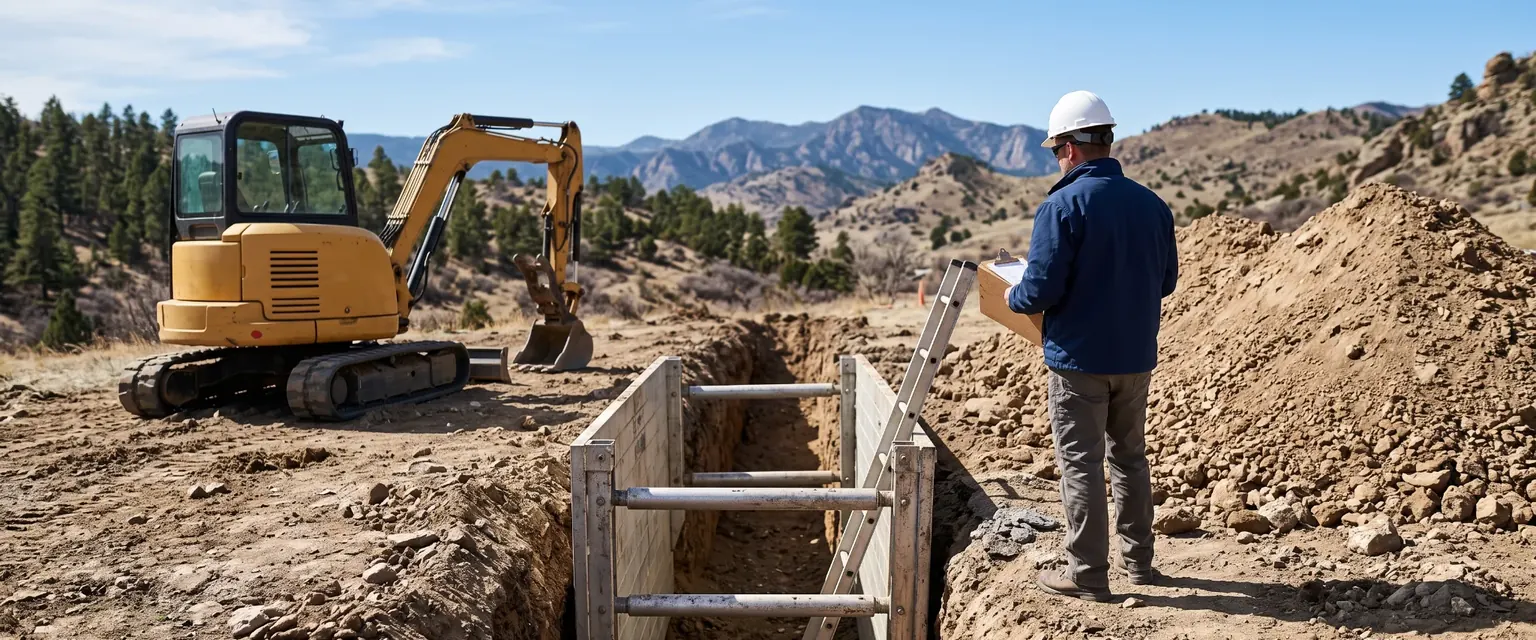
The first question decides which policy answers. The second decides how big the claim is. The third decides how the whole thing gets argued, because a collapse with a trench box in place and a daily inspection log reads very differently from a collapse in an open cut with nobody able to say who the competent person was.
A cave-in rarely gives you time to think about any of that. The soil decides. Expansive clay on the Front Range holds a vertical wall for two dry days and lets go after a night of rain. Decomposed granite above 9,000 feet runs like sugar the moment it dries out. Bentonite near Bailey swells, slumps, and takes the spoil pile with it. None of that is exotic. It’s Tuesday.
Your worker: workers’ compensation
If the person in the trench is your employee, the injury is a workers’ compensation claim. Medical, wage replacement, and in the worst case the death benefit, paid by the comp carrier under the statute rather than argued out in a lawsuit. That’s the trade the system makes: the employee gets benefits without proving fault, and in general the employer gets protection from being sued by that employee for the same injury.
Two things about Colorado that catch trenching outfits.
One employee is the threshold. Colorado employers must carry workers' compensation insurance as soon as they have one or more employees, whether part-time, full-time, or family members (C.R.S. 8-40-203(1)(b), 8-44-101); the state can fine an uninsured employer up to $500 for every day without coverage. (C.R.S. 8-40-203(1)(b); 8-44-101; 8-43-409) A laborer you brought on for a three-week sewer tap counts. So does your brother-in-law running the plate compactor. The one-employee article covers the rest.
The 1099 in the trench may not be a 1099. Under C.R.S. 8-40-202(2)(a), anyone who performs services for pay for another is deemed an employee unless the person is free from control and direction in performing the service, both under the contract and in fact, and is customarily engaged in an independent trade, occupation, profession, or business related to the service; a signed written document showing the nine factors in 8-40-202(2)(b)(II), with a conspicuous disclosure that the contractor is not entitled to workers' compensation benefits, creates only a rebuttable presumption of an independent contractor relationship. (C.R.S. 8-40-202(2)(a), (2)(b)(I) to (IV)) A laborer you pay by the day, direct on the site, hand a shovel, and tell where to stand is generally an employee under that test no matter what the tax form says. If he’s hurt in a cave-in and you have no comp, you’re looking at the injury, the state’s penalties, and a lawsuit with no exclusive-remedy protection behind it.
What comp doesn’t do: pay the other contractor’s worker, pay the property damage, or pay the fine. Those go elsewhere.
Someone else’s worker or the public: general liability
A sub’s laborer bedding pipe in your trench. The plumber’s apprentice who climbed in to check the tap. A homeowner who walked over to look. When someone who is not your employee is hurt in a collapse, the claim comes to your general liability policy as third-party bodily injury.
The sub’s own comp pays the sub’s worker first, if the sub has it. Then the worker’s attorney looks at everyone else on the site, and the outfit that dug the hole is the first name on the list. Under most standard forms, the GL typically responds to that claim and to your defense, subject to the limits and the policy language.
Now the property. A trench in Denver clay that sloughs takes the water main in the sidewall, undermines the sidewalk, and on a bad day cracks the neighbor’s foundation. All of that is property damage to someone else, which is the reason a GL exists.
Except on one kind of form. The C in XCU is collapse: structural damage to a building or other structure caused by grading, excavating, filling, or shoring. Some GL forms exclude it by endorsement, usually tied to a class code, and a trenching outfit with that endorsement has a policy that steps back from the exact claim the trade produces. The XCU article explains where to find the line on your endorsement schedule. It doesn’t show on the dec page.
The 5-foot line and the competent person
Liability arguments after a collapse run through one federal rule, and it’s shorter than people think.
Here’s what that means for the claim. The competent person’s name, training, and daily log are the first documents the carrier asks for. If the trench was boxed and inspected, the property damage and third-party claims tend to get paid as an accident, which is what the policies are for. If it was an open cut at 7 feet with no protection, the same policies typically still respond to the third parties, but the defense is harder, the OSHA citation follows, and the carrier’s underwriters remember it at renewal.
What no policy pays, under most standard forms: the OSHA fine, damage to your own work (the pipe you were laying, the bedding, the backfill), and your own machine. The mid-size excavator sitting on the edge of the cut when the wall lets go and slides in is an equipment claim, on that policy or not at all.
How a collapse claim actually stacks up
Take one event. A crew is setting a sewer service in a 7-foot trench on a residential street in Denver. The wall on the uphill side has held for two days. A storm comes through overnight, nobody re-inspects, and the wall goes at 9 a.m. with a laborer and a sub’s plumber in the hole.
| The bill | Which policy | Notes |
|---|---|---|
| Your laborer’s injury | Workers’ compensation | No-fault benefits; the comp carrier handles it |
| The sub’s plumber | His employer’s comp first, then your GL for the third-party claim | The GL claim is where the limit gets tested |
| The water main in the sidewall | General liability | Underground property damage; the U in XCU |
| The sidewalk and the neighbor’s footing | General liability | Collapse; the C in XCU |
| Your excavator that slid into the cut | Contractors equipment | Not a GL claim on any form |
| The pipe and bedding you were installing | Nobody, under most forms | Your own work |
| The OSHA citation | Nobody | Fines are yours |
Two serious injuries and a foundation repair on the same day is where a $1M occurrence limit starts to feel small. That’s the umbrella conversation, and it’s why utility trenching and grading contracts ask for one.
What we don’t control
The carrier reads the collapse against your documentation, and the carrier decides the claim. What we can do is make sure the GL form doesn’t carry the collapse exclusion, the comp is in place before the first day of payroll, the umbrella sits over both, and the equipment schedule has the excavator at a number that replaces it. And when something happens in the hole, the first-hour checklist applies to a collapse too: people first, then the scene, then the phone.
Where to go from here
If you open trenches deeper than your knees, pull your GL endorsement schedule and look for the word collapse. If you’re not sure what you’re reading, Get Insured lists what to have ready, and the first questions we ask a trenching contractor are how deep you go, what you box with, and who your competent person is. No online quote, on purpose.
Serving businesses located in Colorado. Coverage is determined by the policy language and the carrier.
Is a trench collapse covered by general liability?
At what depth does OSHA require a trench box or sloping?
Can an injured employee sue me after a trench collapse in Colorado?
Who is liable if a subcontractor's worker is hurt in my trench?
Does insurance pay OSHA fines after a cave-in?
Sources
- 29 CFR 1926.652, Requirements for protective systems (eCFR) (accessed 2026-09-03)
- 29 CFR 1926.651, Specific excavation requirements (eCFR) (accessed 2026-09-03)
- Colorado Department of Labor and Employment, Workers' compensation insurance coverage for employers (accessed 2026-09-03)
- C.R.S. 8-40-202, Definition of employee (independent contractor test) (accessed 2026-09-03)
Related articles
Read next
-
 Claims · 7 min read
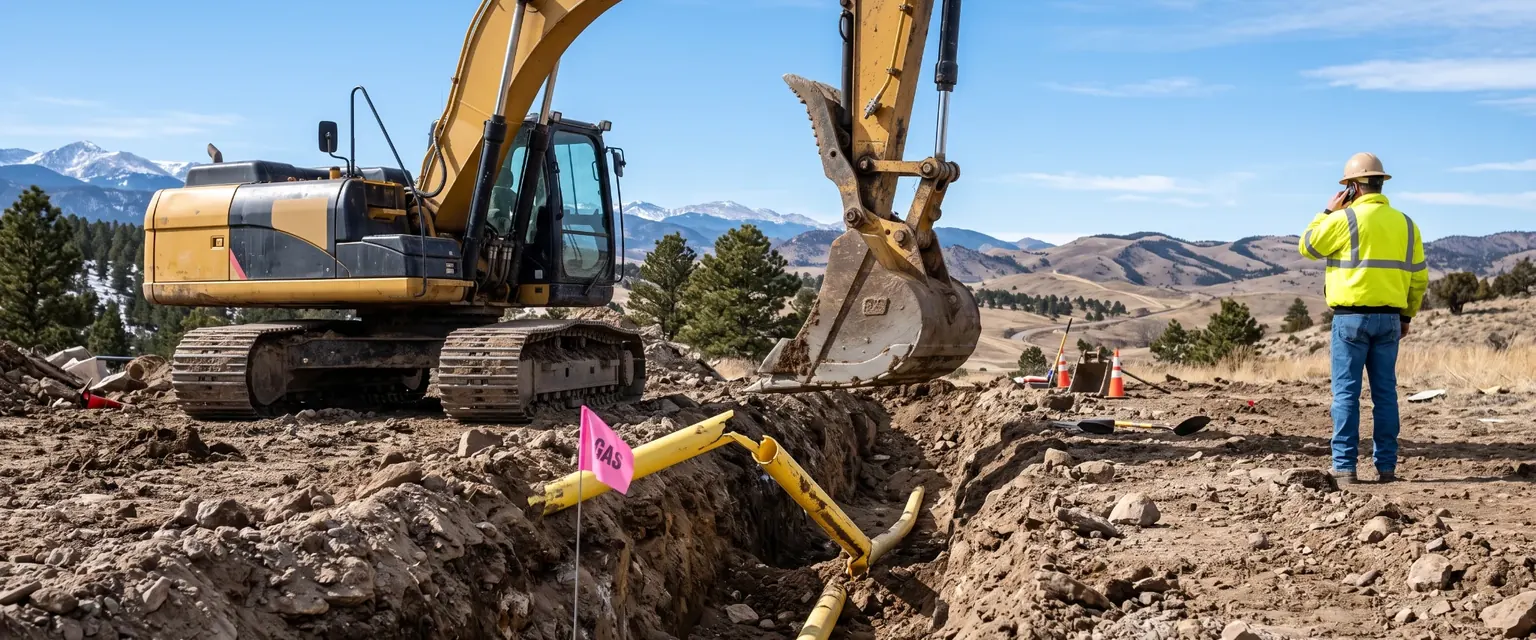
 The first hour after a utility strike, as a checklist
A numbered checklist for the first hour after a utility strike in Colorado: people, calls, photos, the ticket, the carrier, and what not to sign or pay. Read the article - Coverage explained · 7 min read
XCU: the three letters that decide whether your GL works on a dig
What XCU coverage is: explosion, collapse, and underground damage, why some GL forms exclude all three, where the line hides, and what it means on a dig. Read the article - Contracts and COIs · 9 min read
Subcontractor with no insurance? That's your claim now.
An uninsured sub's injury, utility strike, or wrecked truck comes to you. The certificate to collect, additional insured, and the audit charge. Read the article - Coverage explained · 8 min read
Workers comp in Colorado starts at one employee. Seasonal counts.
Colorado requires workers comp the day you hire your first employee, part-time or seasonal, family or not. The statute, the fine, and what a small outfit does. Read the article
Statutes and numbers on this page last verified September 3, 2026 by a licensed Colorado producer. How we verify.