Resources · Claims
The first hour after a utility strike, as a checklist
The honest answer is that the first hour after a utility strike decides most of what the next six months cost, and almost none of it is about money. It’s about who’s standing where, which three phone calls happen in which order, and whether anyone took a picture of the paint before the utility crew dug it up. Tape this to the visor. We write excavation insurance in Colorado and we’ve stood over the hole, so here’s the hour as a numbered list, then what each step is for.
The checklist
- Stop the machine. Shut it off. Not idle. Off. A running engine next to a gas leak is an ignition source, and a bucket that keeps moving makes the damage worse.
- Get people out and upwind. Everyone in the trench comes out. Everyone on the site moves upwind of a gas leak and away from a downed or exposed electrical line. Keep the public back. If the machine is in contact with an energized line, the operator stays in the seat until the utility says it’s dead, unless the machine is on fire.
- Call 911 for gas, electric, or any injury. Don’t debate whether it’s a big leak. Dispatch would rather send an engine to a small one.
- Call the utility’s emergency number. It’s on the marks, on the ticket, and on the meter. They shut the line off and send the crew. Say what you hit, where, and whether it’s leaking or arcing.
- Call Colorado 811 and report the damage. This puts the strike on the record against your ticket number, and the ticket number is the thing that decides who’s presumed liable.
- No repairs. No backfill. No crimping. Not even the water line that looks like an easy fix. Expose the damage if it’s safe to, then leave it alone.
- Photograph everything before the utility crew arrives. The marks, their color, and their distance from the actual line with a tape in the frame. The hole. The damaged line and the tracer wire. The bucket or tooth. Wide shots showing where the machine was working relative to the paint. The ticket number on your screen. Their repair erases the evidence you need.
- Write down who, what, and when. Operator’s name, time of the strike, weather, who called whom, and the utility crew’s names and truck numbers when they arrive. A text to yourself works.
- Confirm the ticket was alive. Pull it up. Check the dig date and the marking date. Marks have a shelf life, and a ticket from a job that paused for rain may have expired.
- Call us, and report it to the carrier the same day. Not tomorrow. Reporting is not filing a claim; it satisfies the notice condition on the policy before the utility’s claims department has a file open.
- Don’t sign anything, and don’t pay anything. No acknowledgment of fault, no invoice on the spot, no “we’ll just settle this between us.” Give the utility crew your contact information and the carrier’s claim number when you have one.
- Preserve the site until the adjuster says otherwise. If you have to keep working, work somewhere else on the lot. Leave the strike area, the spoil, and the marks as they are.
That’s the hour. Everything below is why.
What to have in the truck before it happens
Already in the cab
- The current 811 ticket, printed or saved offline on the phone
- The utility emergency numbers for the area written on the ticket (gas, electric, water, fiber)
- A tape measure and a can of white paint for the photos
- The carrier's claims number and our phone number, (720) 529-0300, on the visor
- A one-page incident sheet with blanks for time, operator, ticket number, and who was called
- An extinguisher rated for the machine, checked this season
None of that costs much. All of it is impossible to find at 2 p.m. with gas in the air.
Why the order matters
People before paint. Steps 1 through 4 are about nobody getting hurt, and they’re the only steps where the order isn’t negotiable. Gas finds ignition sources you didn’t think of, and an exposed electrical service in a wet trench on the Front Range is the kind of thing that kills the person trying to help.
The record before the repair. Steps 5 through 9 exist because of one sentence in Colorado law.
Step 9 is the one crews skip. Locate markings stay valid while clearly visible, but for no more than thirty calendar days after the locate request due date (C.R.S. 9-1.5-103). (C.R.S. 9-1.5-103) A job that paused for a wet week and started again on a stale ticket is a strike with no valid notice, and that’s the version of the presumption you don’t want to argue. The Colorado 811 article covers the dates.
The carrier before the invoice. Steps 10 and 11 are about your policy’s conditions. Every general liability form has a notice condition, and the carrier reads the strike against your ticket, your photos, and how fast they heard about it. A strike reported the day it happened is an accident. A strike the carrier learns about from a utility’s attorney six weeks later is an argument. Signing an acknowledgment of fault or paying the first invoice on the spot doesn’t make it go away; it just takes the decisions out of the adjuster’s hands and puts them in yours, without the policy behind you.
What the policies do, and what comes to you
Quick version, because the gas line article has the long one.
| The bill | Where it typically goes |
|---|---|
| The utility’s repair and their other costs | General liability, on a form without the underground exclusion |
| Third parties: the evacuated block in Colorado Springs, the neighbor’s flooded basement | General liability, bodily injury and property damage |
| A cut sewer main or a ruptured fuel line into a creek crossing | Typically a pollution liability question, not GL |
| Your own machine, if the strike damaged it | Contractors equipment, not GL |
| Commission fines and civil penalties | You. Neither the commission’s fines nor the statute’s civil penalties are insurable under most standard forms |
On that last row: Separately from commission fines, C.R.S. 9-1.5-104.5 lets an owner, operator, excavator, aggrieved party, district attorney, or the attorney general sue for civil penalties: $200 for excavating without notice, and $5,000 for a first offense (up to $25,000 for later ones, and up to $75,000 after more than three in twelve months) when that failure damages a facility. (C.R.S. 9-1.5-104.5(2)(b), (2)(c), (3)) The safety commission’s own fine schedule is a second system on top of that, and the 811 article has both tables. Neither one is a claim. Both are the reason step 9 is on the list.
The row that decides everything is the first one. Some GL forms exclude underground property damage entirely. The XCU article explains where that line hides on the endorsement schedule, and a utility trenching crew running on a form that carries it is running without the coverage this whole checklist assumes.
After the hour
The utility’s first invoice usually arrives within a few weeks and it’s rarely the last one. Send every invoice, letter, and locate record to the adjuster and to us the day it arrives. Ask the utility, in writing, for their locate records and the marking date. If the marks were wrong, say so once, in writing, with the photos attached, and then let the carrier’s people do the arguing. The claims page has the same first hour for injuries, vehicle accidents, and slip-and-fall notices.
Where to go from here
If you hit something today, call. That’s the one we answer first. If you haven’t hit anything and you want to know whether your GL would actually respond when you do, send the dec pages and the endorsement schedule through the policy review and we’ll mark the underground exclusion and the notice condition against the work you do.
Serving businesses located in Colorado. Coverage is determined by the policy language and the carrier.
Do I have to call 811 after I hit a line, or just the utility?
Should I try to repair the line myself?
What should I photograph after a utility strike?
Does reporting a strike to my carrier raise my rates?
Sources
- C.R.S. 9-1.5-104.5, Civil penalties and presumed liability (Colorado Excavation Requirements) (accessed 2026-09-03)
- C.R.S. 9-1.5-103, Notice of excavation and marking of underground facilities (accessed 2026-09-03)
- Colorado 811 (accessed 2026-09-03)
Related articles
Read next
- Excavation · 7 min read
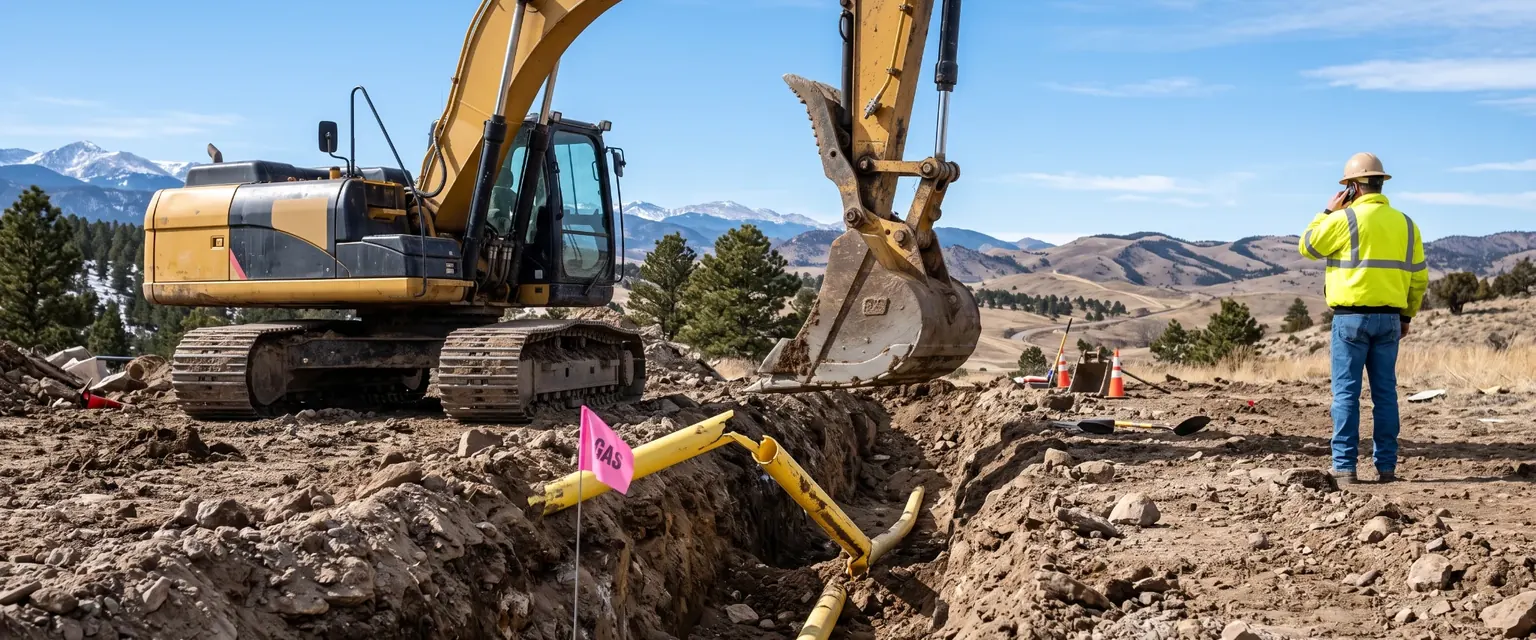
You hit a gas line. Here's who pays, and what your policy has to say about it
Hit a gas line while digging in Colorado? Who pays depends on your locate ticket, the marks, C.R.S. 9-1.5, and the XCU line in your GL. How the claim unfolds. Read the article -
 Colorado law · 8 min read
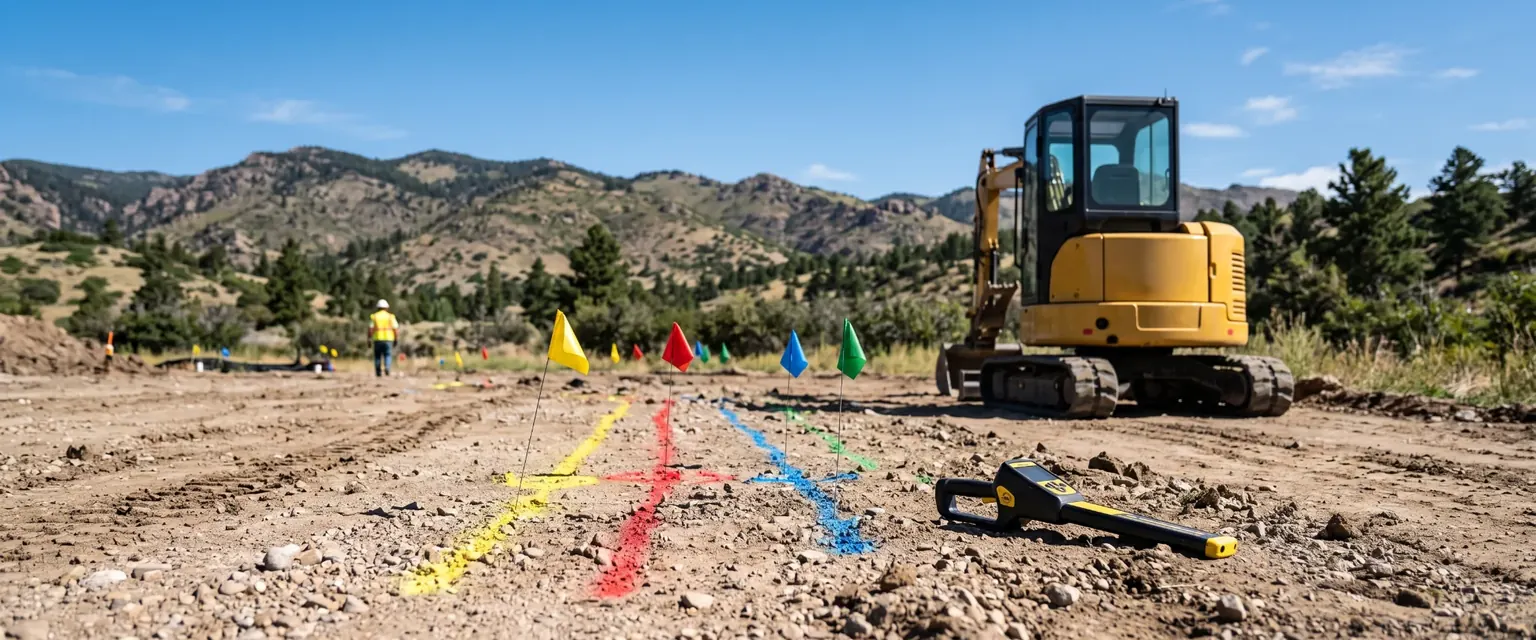
 Colorado 811: the two-business-day rule, the fines, and the part contractors get wrong
Colorado 811 for contractors: the statute says two business days, 811 says three, marks last 30 days, fines run $250 to $75,000. The part people get wrong. Read the article -
 Excavation · 8 min read
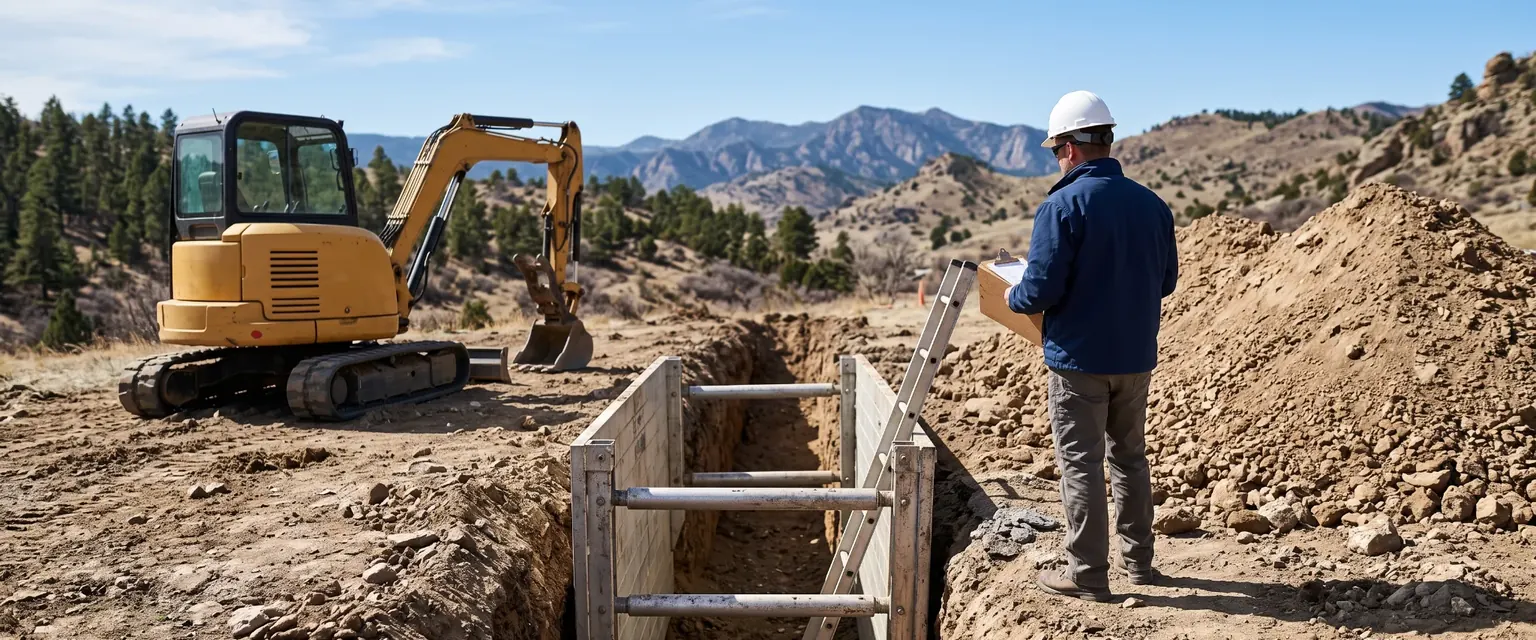
 Trench collapse: who is liable, and what your GL and comp actually do
Trench collapse liability in Colorado: who is liable for your worker, a sub's worker, and the neighbor's property, and what GL and comp actually do. Read the article - Coverage explained · 7 min read
XCU: the three letters that decide whether your GL works on a dig
What XCU coverage is: explosion, collapse, and underground damage, why some GL forms exclude all three, where the line hides, and what it means on a dig. Read the article
Statutes and numbers on this page last verified September 2, 2026 by a licensed Colorado producer. How we verify.