LANDSCAPING TRADE
Tree Service Insurance in Colorado
Tree work is the landscaping trade carriers are most careful with, and the one landscapers most often do without telling anyone. Here's what a Colorado tree service policy has to cover, and why the honest answer starts with whether a carrier will write it at all.
Tree work is not landscaping with a chainsaw. It rates separately, it is underwritten separately, and some carriers won’t touch it. We say that on the first call because a declined renewal is usually what puts a tree contractor on the phone, and a landscaper often doesn’t know that the “little tree work” on the side isn’t on the policy at all. This page sits under our landscaping hub. If most of your work is mulching and clearing rather than climbing, the land clearing and forestry mulching page is the better fit.
What the underwriter sees on a tree service application
Height, method, and lines.
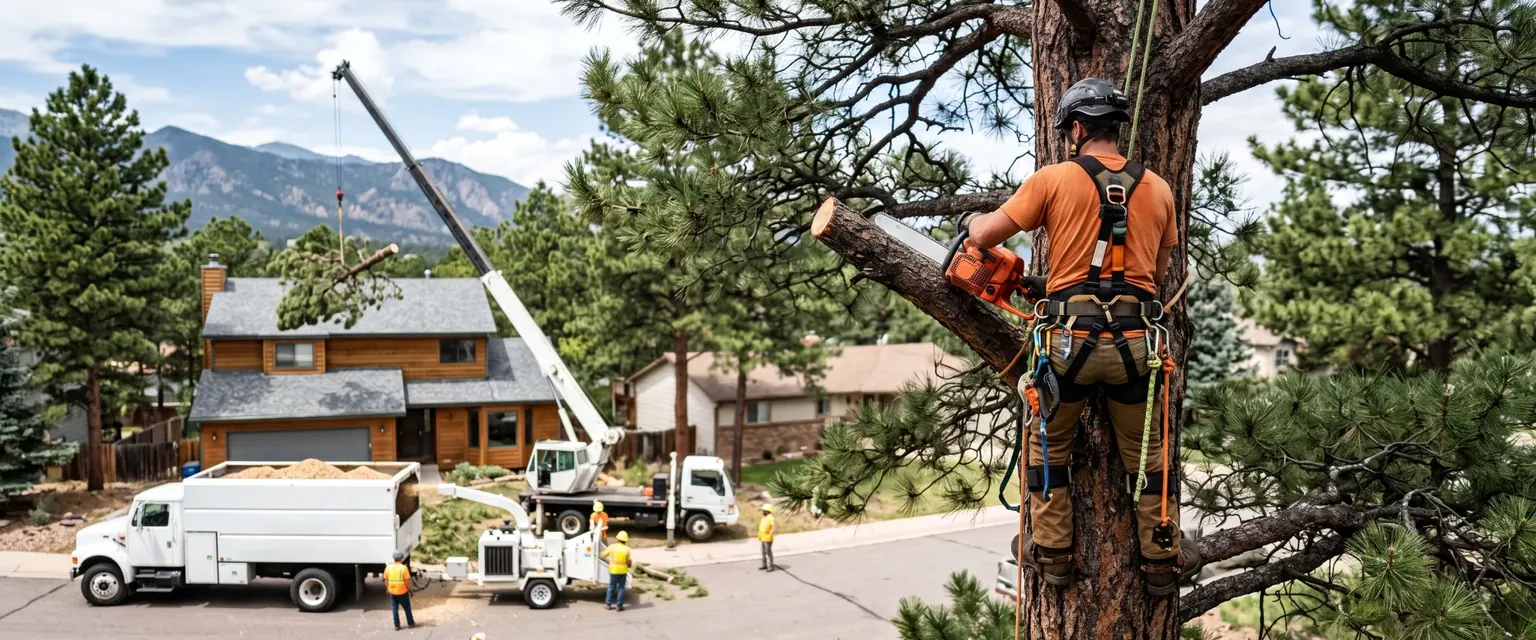
Height means the tallest tree you’ll take down and whether you climb it, bucket it, or crane it. Method means rigging, spikes, ropes, aerial lifts, and who trains the crew. Lines means whether you work near energized conductors, and whether you do utility line clearance at all, which is its own specialty and commonly excluded on a standard tree policy.
Then the rest. Trimming versus removals. Crew size and payroll, because workers’ comp on a climbing crew is the largest line in the stack and the hardest to place. Equipment: bucket truck, Vermeer or Bandit chipper, stump grinder, the mini skid steer with a grapple, saws. Certifications. Subcontracted climbers. Fire mitigation work and where. Loss runs.
The candid part. Some markets restrict tree work to a height, exclude removals, or decline it outright. The underwriter is trying to sort you from the landscaper who took a removal because the customer asked, and that landscaper is the exposure carriers fear most, because nobody rated it. If you are that landscaper, tell us. It is fixable before a claim and expensive after.
Colorado adds a few lines. Chinook winds from Boulder to Fort Collins turn a routine trim into a rigging problem. Early and late storms load cottonwoods in Loveland while the leaves are still on, and limbs come down on roofs for a week afterward. Beetle-kill lodgepole above 8,000 feet in Eagle County is brittle, hangs up, and burns.
The five exposures that produce tree service claims
- A limb through the roof. A 70-foot cottonwood removal in Loveland after an October storm loaded leafed-out limbs with wet snow. A piece swings on the rigging, goes through the roof, and lands in the kitchen. General liability, and the first question is what your policy says about removals.
- Power line contact. A climber trimming a silver maple in Boulder’s Mapleton Hill on a Chinook-wind afternoon drops a limb across the service drop. The outage, the pole, and the neighbor’s electronics are the claim, and some forms restrict work near energized lines.
- Climber and groundman injuries. A groundman feeding a Vermeer chipper on a steep lot above Vail loses footing in decomposed granite. Workers’ compensation, and tree work is among the harder classes to place in Colorado.
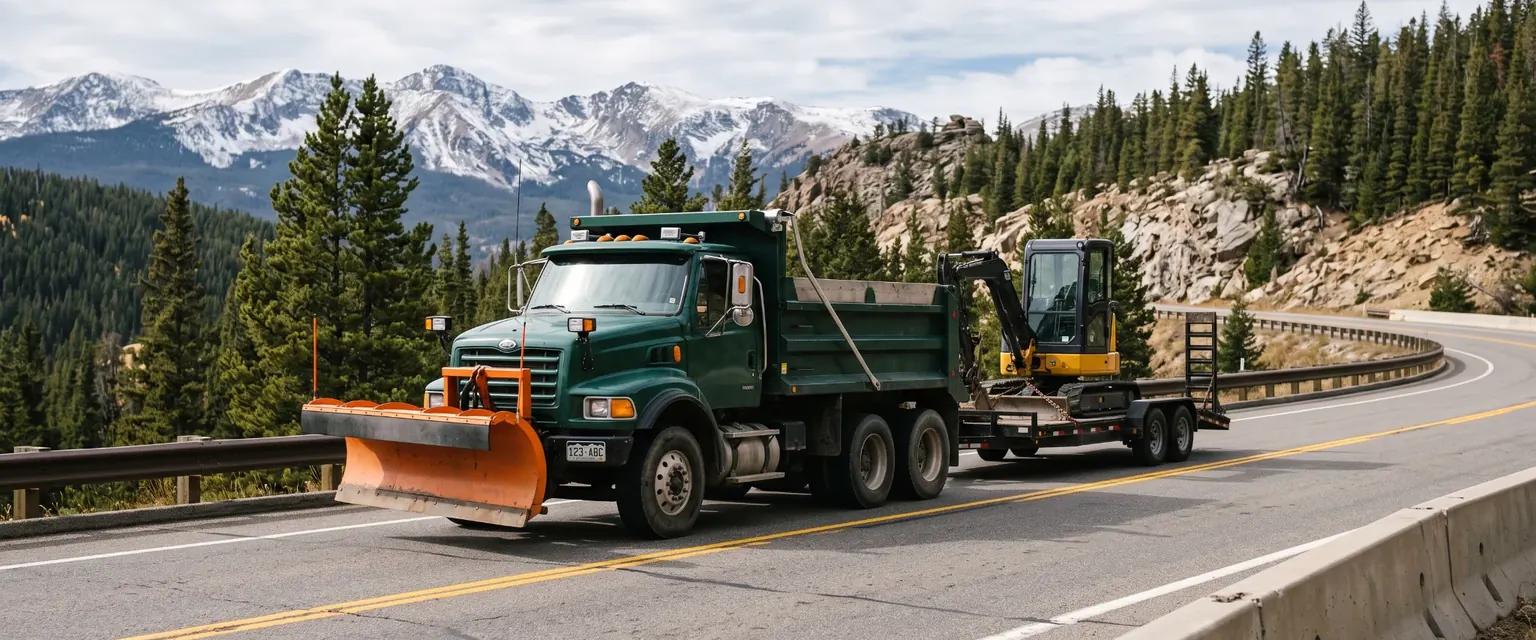
- The bucket truck and the chipper on the road. A bucket truck towing the chipper down I-70 from Vail Pass in a spring snow jackknifes on the Dowd Junction curve. Commercial auto for the truck and the trailer; the boom is a question for the policy language.
- Fire mitigation thinning in the WUI. A crew thinning beetle-kill lodgepole above Nederland on a red flag day. A saw, a hot muffler on a Yanmar mini skid steer, or a chain on rock starts a grass fire. The wildfire exposure is real and the underwriter asks about it.
Things go wrong on tree jobs more than most. The stack below is built so each of these lands on a policy that was written knowing that.
The coverage stack we’d build
| Coverage | Why | Typical contract requirement |
|---|---|---|
| General liability, with tree work disclosed, removals and height stated | The roof, the fence, the neighbor’s car, the service drop, and the defense on each. Read the form for height limits and line-work exclusions. | $1M per occurrence / $2M aggregate; HOA, city, or GC as additional insured |
| Workers’ compensation | Falls, cuts, chipper injuries, struck-by. Required at the first employee, and the class rates high because the injuries are serious. | Statutory; waiver of subrogation on municipal and commercial contracts |
| Commercial auto | Bucket truck, chip truck, the chipper and stump grinder in tow. Personal auto forms commonly exclude business use. | $1M combined single limit; hired and non-owned for the climber who drives his own truck |
| Contractors equipment (inland marine) | Chipper, stump grinder, mini skid steer, saws, rigging gear, and sometimes the aerial device. Theft from the yard and a chipper rolled on a slope. | Your lender, not your customer |
| Umbrella / excess | A climber’s injury or a house fire goes past $1M. Municipal forestry and utility contracts commonly ask for the layer. | $2M to $5M on municipal, utility, and fire mitigation contracts |
The lines that bite are the ones written into the GL form itself. Still covered on a tree policy written by a carrier that writes tree work: the limb on the roof, the fence, the injury to a passerby, the defense. Commonly excluded or limited even then: work near energized lines, removals above the stated height, damage to the tree you were hired to trim, and pollution from a fuel spill. On a landscaping policy that never mentioned trees, the argument starts before coverage does.
Contract requirements you’ll run into
Most residential tree work is a handshake and an invoice. The paper shows up on:
- HOAs and property managers. $1M/$2M general liability, additional insured, primary and non-contributory, and a waiver of subrogation. Some want a per-project aggregate.
- Municipal forestry. Cities along the Front Range bid pruning and removal contracts with higher limits, an umbrella, and sometimes a bond. Fort Collins and Loveland and Boulder and Longmont each run their own forestry programs with their own paper.
- Utility line clearance. A different business. Specialty coverage, specialty training, and a contract that assumes both. If a landscaping-based tree policy is what you have, it commonly excludes this work.
- Fire mitigation contracts. USFS, state, county, and fire district work in Eagle County and along the Front Range asks for general liability, auto, workers’ comp with a waiver, and sometimes written fire procedures. The wildfire exposure is the underwriting question; the indemnity clause is the legal one.
Colorado notes for tree contractors
Class codes. Landscaping contractors are typically rated under NCCI code 0042 (Landscape Gardening & Drivers; lawn maintenance under 9102), excavation under 6217 (Excavation & Drivers), tree work under 0106 (Tree Pruning), and stand-alone snow-clearing under 9402 (Street Cleaning & Drivers); the carrier makes the final assignment under NCCI rules. (NCCI Scopes Manual) [VERIFY] Tree pruning is its own code. A landscaper who removes trees needs that payroll split out, and a carrier that finds undisclosed tree work at audit is a carrier that starts asking about the rest of the application.
Workers’ comp. Colorado employers must carry workers' compensation insurance as soon as they have one or more employees, whether part-time, full-time, or family members (C.R.S. 8-40-203(1)(b), 8-44-101); the state can fine an uninsured employer up to $500 for every day without coverage. (C.R.S. 8-40-203(1)(b); 8-44-101; 8-43-409) The climber counts. The groundman counts. The high schooler dragging brush for the summer counts.
The 1099 climber. Colorado’s test for who counts as an employee does not turn on what the check says. Under C.R.S. 8-40-202(2)(a), anyone who performs services for pay for another is deemed an employee unless the person is free from control and direction in performing the service, both under the contract and in fact, and is customarily engaged in an independent trade, occupation, profession, or business related to the service; a signed written document showing the nine factors in 8-40-202(2)(b)(II), with a conspicuous disclosure that the contractor is not entitled to workers' compensation benefits, creates only a rebuttable presumption of an independent contractor relationship. (C.R.S. 8-40-202(2)(a), (2)(b)(I) to (IV)) A climber working your jobs under your direction with your gear is often an employee in the state’s eyes regardless of the 1099; ask a Colorado employment attorney on the classification question.
Trucks. Colorado requires minimum auto liability limits of $25,000 per person and $50,000 per accident for bodily injury and $15,000 per accident for property damage (C.R.S. 10-4-620; 42-7-103(14)(a)), unchanged as of 2026; commercial contracts commonly ask for $1,000,000 combined single limit instead. (C.R.S. 10-4-620; 42-7-103(14)(a)) A bucket truck with a chipper in tow is a commercial vehicle by any reading, and the contract wants $1M.
Stump grinding and planting. Colorado law requires notice to Colorado 811 at least two business days before excavating, not counting the day you call (C.R.S. 9-1.5-103(3)(b)); Colorado 811 phrases the same window as three full business days, so a Monday call means a Thursday dig. (C.R.S. 9-1.5-103(3)(b)) A stump grinder and a tree-planting auger both disturb the ground. Our read is the locate statute applies; the ticket costs nothing either way.
Licensing is local. Some Front Range cities license or register tree contractors through the city forester, and some don’t. We don’t list them here because the rules are set city by city and change; the forester’s office is the source. Expect the ones that license to ask for a certificate with the application.
Wildland-urban interface. Boulder County, Eagle County, and most mountain jurisdictions have defensible space and wildfire codes that shape mitigation work. We don’t quote those codes here because they change by county and by year; the county wildfire mitigation office is the source. Where they matter to insurance is the application: mitigation work in the WUI is a fire exposure, and an underwriter wants to know how you handle red flag days.
Where to go from here
Already carry a policy? Send the dec pages to the policy review and we’ll mark the height limit, the removals wording, and the line-work exclusion against the trees you actually take down. Starting fresh, or coming off a declined renewal? Get Insured lists what to have ready. No online quote. Tree work is placed carrier by carrier.
Serving businesses located in Colorado. Coverage is determined by the policy language and the carrier.
Coverage
Coverage built for tree service.
-
 Coverage
General liability
Pays when your work hurts someone else or their property. The one every GC asks about first. General liability explained -
 Coverage
Workers' compensation
Pays your employee's medical and lost wages when they get hurt. Required at the first hire in Colorado. Workers' compensation explained -
 Coverage
Commercial auto
Covers the dump truck, the plow truck, and the crew pickup on the road. Personal auto typically won't. Commercial auto explained
Does my landscaping policy cover tree removal?
Why is tree service insurance hard to get in Colorado?
My climber is a 1099. Do I still need workers' comp?
Is my bucket truck commercial auto or inland marine?
Statutes and numbers on this page last verified September 3, 2026 by a licensed Colorado producer. How we verify.