Resources · Coverage explained
You rented the excavator. Who pays when it goes in the pond?
The honest answer is that the rental agreement already decided who pays. You did. From the minute the mid-size excavator comes off the yard’s lowboy until it goes back on, most rental contracts make you responsible for the machine regardless of cause, and a pond doesn’t count as an excuse. The only questions left are which of your policies responds, whether the yard’s damage waiver is worth what they charged for it, and how big the gap is between the two. The contractor’s equipment policy is where the answer usually lives, and it’s also where the gap usually hides. Here’s how to find both before the machine is in the water.
Read the rental agreement once, slowly
Every rental yard’s agreement is a little different and they all say the same three things. Find them in yours.
Responsibility from pickup to return. You’re responsible for loss or damage to the machine while it’s in your possession, whether or not you caused it. Theft off your job, a rollover, a fire, hail on the cab, a boulder through the glass. All yours.
Replacement at the yard’s number. If it’s a total loss, you owe what the yard says it costs to replace, which is typically new-replacement cost, not what the eight-year-old machine was worth. The yard is not going to settle at actual cash value.
Loss of rental income. While the machine is down, the yard wasn’t renting it to anyone else. Many agreements make you responsible for that too, sometimes for the whole repair period.
There’s often a fourth: you agree to carry insurance on the machine, name the yard as loss payee, and produce a certificate on request. Some yards enforce it. Some just charge you for the waiver if you don’t.
The loss damage waiver
At the counter, the yard offers a damage waiver (loss damage waiver, rental protection plan, the names vary) for a percentage of the rental charge. Here’s what it is and isn’t.
It is the yard agreeing not to hold you responsible for certain damage, up to a point, for a fee. It is not an insurance policy. Nobody underwrote it, no carrier stands behind it, and its terms are whatever the yard wrote.
The exclusions are the part to read, because they tend to be the exact ways machines get hurt on our jobs. The exclusions that show up in most rental waivers: operation in water or beyond the rated depth. Overloading or exceeding the machine’s rated capacity. Theft without a police report or without the keys removed. Damage to tires and tracks. Misuse, operation by someone not authorized, or use in violation of the agreement. Loss of rental income, often. And a deductible or a cap, sometimes both.
So the excavator that slides into a pond while you’re cleaning the outlet on a grading job near Frisco is a water-operation loss, and the waiver you paid for may say nothing at all. The one that walks off a lot above Bailey with the key in it is a theft-without-keys-removed loss. The waiver is a real product and it’s worth something on a plain rollover. It’s not the whole answer.
Where your own policy picks it up
Two policies come up, and only one of them typically responds.
General liability is for damage you do to other people’s property while working. Most standard GL forms exclude damage to property in your care, custody, or control, and a machine you signed for and are operating is the definition of that. Don’t expect the GL policy to pay for the rented machine. It may respond if the machine damages a neighbor’s fence on the way into the pond, which is a different claim.
Contractor’s equipment (inland marine) is where rented equipment belongs. The policy insures machines you own, and under most standard forms it can be extended to machines you rent or lease and are responsible for under a written agreement. That extension is where every one of the gaps below lives, so pull your dec page and look for it by name: rented or leased equipment, equipment of others in your care, or similar. If it isn’t there, you’re relying on the waiver and your own checkbook.
The gap, in five places
Assume the extension is on the policy. Here’s where the number the yard sends and the number the carrier pays typically come apart.
The any-one-item limit. Rented equipment coverage usually carries a limit for any single machine and a total for the term. Those limits were picked on a day you don’t remember, for the machines you rented then. If the limit is sized for a skid steer and you rented a mid-size excavator for a month, the difference is yours. The schedule-values article makes the same point about owned iron, and rentals drift the same way.
Settlement basis. The yard wants new-replacement cost. Your form may settle rented equipment at actual cash value, or at replacement cost, or at the amount you’re legally liable for under the agreement, depending on the wording. The last one is the one you want. Read which you have.
Loss of rental income. Some rented-equipment extensions pay the yard’s lost rental charges while the machine is being repaired. Many don’t, or cap it. The agreement says you owe it either way.
The deductible. You’ll pay it. On a rented machine that’s typically the same deductible as your owned schedule, and it comes out of the number the yard is waiting on.
Transit and the trailer. If you haul the rental yourself, the machine on your trailer on I-70 is a transit question under the equipment policy, and the trailer and truck are a commercial auto question. Rental yards deliver most big iron for a reason. If you pick it up, know which policy has it while it’s on the deck.
Add those up on an excavator in a pond: the carrier pays up to the any-one-item limit, at the settlement basis on the form, less the deductible, possibly with nothing for loss of rental income. The yard bills replacement cost plus rental income for the down weeks. Whatever is between those two numbers is the gap, and it’s usually bigger than anyone expected on a machine they only had for ten days.
The pond, specifically
Water is worth its own paragraph because it’s where the waiver, the policy, and the machine most often meet. Excavators go into ponds and creeks for good reasons: cleaning an outlet, setting riprap, pulling a beaver dam, cutting a channel in spring runoff. They go in past the rated depth for the same reasons, usually with a tired operator on a soft bank in the last hour of the day.
Three things happen at once. The waiver typically excludes operation in water, so it’s out. The equipment policy typically covers the loss under the rented-equipment extension if the extension exists and the loss isn’t excluded, and immersion is a covered peril under many forms but not all; some carry a specific water exclusion, so read yours. And recovery is a cost of its own: a machine in a pond needs a bigger machine or a crane to come out, and whether recovery expense is covered, and to what limit, is a line in the form.
Then the machine itself. A submerged engine may run again after a teardown. Hydraulics and electronics often don’t. The yard will want it back at the number in the agreement. The carrier will want an adjuster’s estimate. Your job in the middle is to report it the same day, photograph everything, and not authorize repairs until both have seen it.
Before the next rental
Five things, done once, that make every rental after that a phone call instead of a fight.
- Find the rented-equipment extension on your dec page and write down the any-one-item limit, the term limit, and the settlement basis. The dec page walkthrough shows where the equipment schedule and its extensions sit.
- Compare the limit to the biggest machine you rented last year. If the limit is smaller, that’s the renewal conversation.
- Read the rental yard’s agreement and waiver once, in the office, not at the counter. Note the water, overload, and theft exclusions.
- Decide the waiver per rental, not by habit. Take it when the machine exceeds your limit or the job is in water and your form excludes it. Decline it when the policy already has it.
- Give the yard a certificate naming it as loss payee if the agreement requires one, and tell us the machine and the dates so the file exists before the loss does.
If you rent in Summit County, where the working season is short and the yards are busy, the extension is what lets you take the machine the day it’s available instead of waiting on paperwork. And if a rental ever leaves a job at night without you, the theft article covers the police report and the underwriting questions, and every one of them applies to a machine you don’t own.
Where to go from here
Send us your dec page and the rental agreement from the last yard you used. A policy review reads the extension against the agreement and tells you where the gap is, in the office, before the pond. The excavation insurance hub covers how the equipment policy fits with the rest of the stack.
Serving businesses located in Colorado. Coverage is determined by the policy language and the carrier.
Does my general liability cover a rented excavator I damaged?
Is the rental yard's damage waiver the same as insurance?
What does rented equipment coverage on an inland marine policy do?
The rental agreement says I'm responsible even if it wasn't my fault. Is that normal?
Related articles
Read next
- Excavation · 9 min read
Equipment theft off a remote Colorado lot: what's covered and what isn't
A machine walks off a remote lot on a Sunday night. What the equipment policy typically pays, what it excludes, the underwriting questions, the police report. Read the article - Coverage explained · 8 min read
Scheduling your equipment: why the number from 2019 will cost you in a claim
Your equipment schedule pays what you wrote down, not what the machine is worth. Scheduled vs blanket, replacement cost vs ACV, coinsurance, and the Bell truck. Read the article -
 Claims · 9 min read
 Colorado hail and your equipment yard
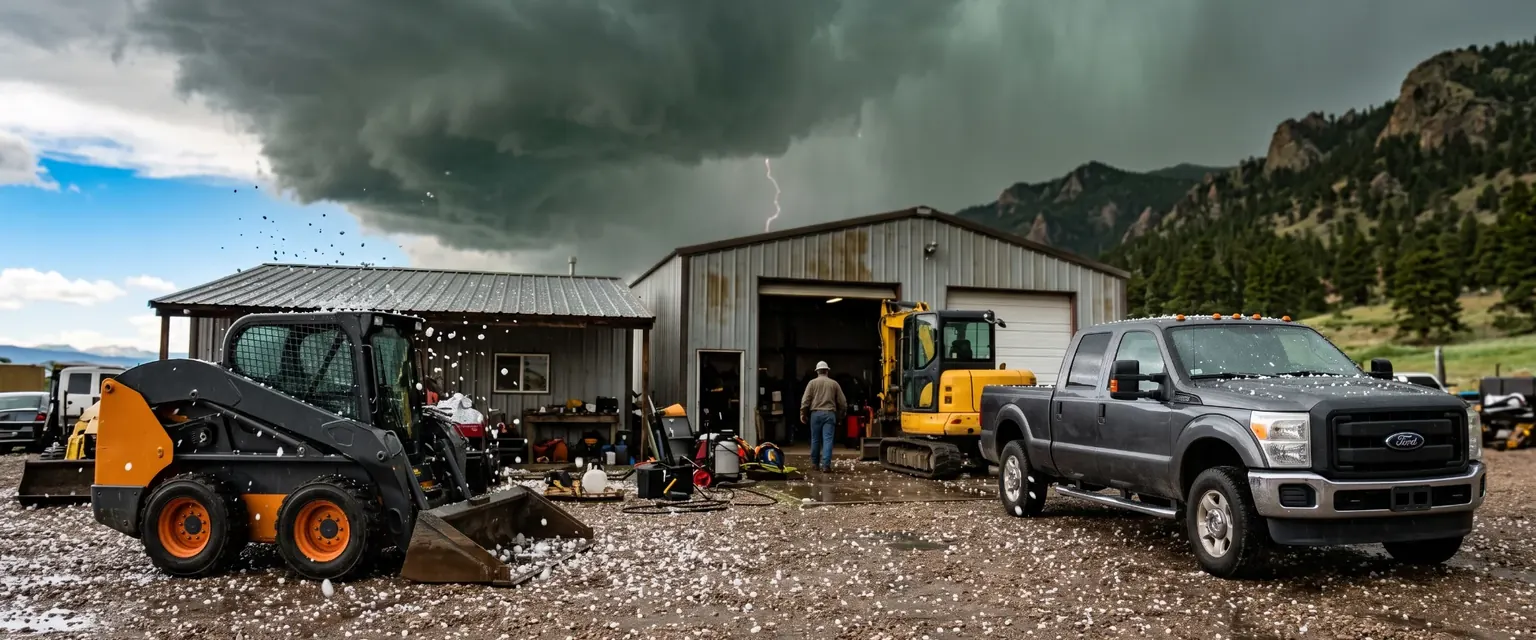
Hail hits the yard, not the job. Which policy pays for the dump truck, the grader cab glass, and the shop roof, how deductibles stack, and what to photograph. Read the article - Coverage explained · 10 min read
Reading your own dec page, line by line
The declarations page is the policy in one sheet. Named insured, limits, classifications, forms schedule, endorsements: what each line says and what to check. Read the article